




Springbok
Antidorcas marsupialis
The springbok is a small, graceful antelope found in southern Africa. They are known for their incredible jumping ability and beautiful tan and white fur.
The Springbok has a striking golden-brown coat with a stark white belly, separated by a dark reddish-brown stripe along its flanks. Its face is white with dark stripes from the eyes to the nose. Both sexes have long, ringed, backward-curving black horns.
Category
MammalsRarity
Common
Danger
1/5 · Very low
Snaps
Be the first to snap!
Both male and female Springboks grow horns, with males having thicker, longer ones.
Springbok herds often include mothers and young, with separate bachelor male groups.
Springboks get most of their water from plants, rarely needing to drink!
Their name "Springbok" means "jump buck" in Afrikaans, reflecting their famous leaps!
Springbok can leap high into the air with an arched back and stiff legs because this unique jump helps them signal danger or show fitness to predators.
Springbok has special adaptations like efficient kidneys and not needing much water to drink because these help them thrive in arid environments.
Springbok can reach speeds of up to 88 km/h (55 mph) and make sudden turns because this incredible agility helps them outrun and evade predators.
Springboks munch on grasses, shrubs, and succulents, getting much of their water from plants!
Acinonyx jubatus
A primary prey for cheetahs on the plains.
Panthera leo
Often targeted by lions, especially the young or weak.
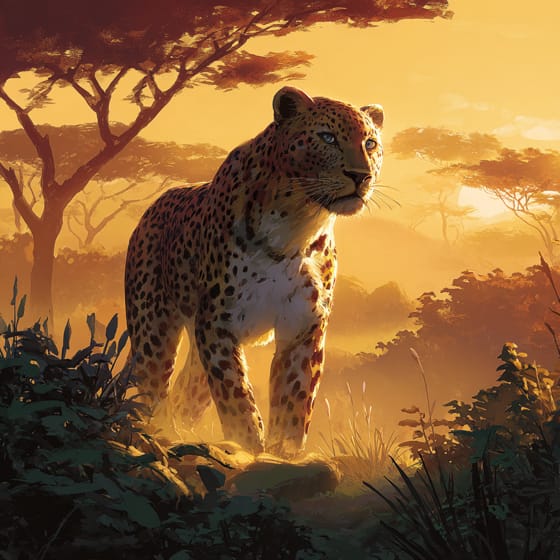
Panthera pardus
Leopards will hunt springboks, particularly smaller individuals.
Furry describes animals possessing a dense covering of soft hair or fur.
Marked with parallel bands or lines of color.
Social animals live in organized groups, cooperating for survival benefits such as foraging, defense, and raising offspring.
Characterized by having one or more hard, permanent, pointed projections on the head.

This trait characterizes organisms whose diet consists entirely or primarily of plant material.
This habitat trait denotes species native to savannas, which are grasslands with scattered trees, typically found in tropical or subtropical regions with distinct wet and dry seasons.

Diurnal animals are primarily active during daylight hours, typically resting or sleeping at night.

This trait identifies organisms that exhibit exceptional swiftness in movement for hunting, escape, or travel.
No aliases listed yet.
Danger
1/5 · Very low
Springboks are gentle animals and not dangerous to people.
The easiest way to identify Springbok is to use the Snappit nature identifier app.
120-150 cm
27-42 kg
7-10 years
88 km/h
Springboks munch on grasses, shrubs, and succulents, getting much of their water from plants!
Grazing
1-2
Zoom in to split clusters and explore where this object has been snapped.
Recent snaps will appear here as new observations are added.
Take the discovery with you
Snap it with Snappit to identify it, learn what makes it special, and add the discovery to your collection.




.jpg&width=800)


.JPG&width=800)


.jpg&width=800)
