




Southern Cassowary
Casuarius casuarius
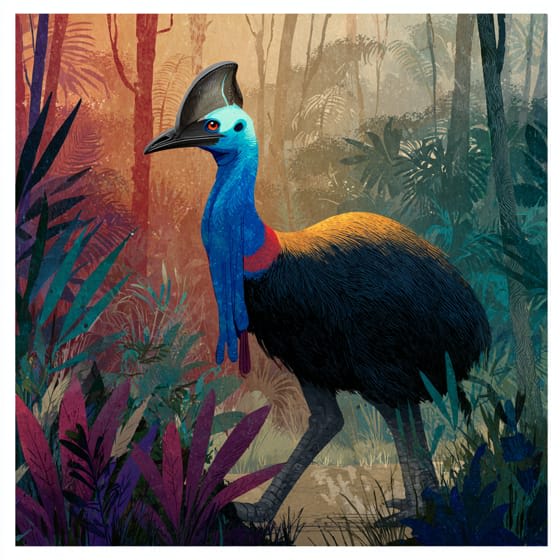
The Southern Cassowary is a large, flightless bird with a colorful neck and a helmet-like crest! They are known for their speed and can run very fast.
Habitat: Tropical rainforests
The Southern Cassowary is a very large, flightless bird with glossy black feathers. It has a tall, bony casque on its head, and bright blue and red skin on its neck and wattle, making it unmistakable.
Category
BirdsRarity
Epic
Danger
2/5 · Low
Snaps
Be the first to snap!
A male cassowary alone cares for its chicks, from incubation to raising them!
Cassowaries can swim surprisingly well, crossing rivers and even sea channels.
Their casque might help them hear low-frequency sounds better.
They swallow large fruits whole, digesting the pulp and dispersing seeds.
Southern Cassowary has a bony casque on its head that helps them push through dense forest and protect their skull.
Southern Cassowary can spread plant seeds widely by eating fruits, helping new trees grow in the rainforest.
Southern Cassowary can make very low-frequency booming calls, helping them communicate over long distances in thick forest.
They mostly feast on fruits that fall to the forest floor, helping many rainforest plants.
Elaeocarpus grandis
Its fruits are a favorite food, spreading seeds.
Syzygium tierneyanum
Aids in the dispersal of this rainforest tree's seeds.
Morelia amethistina
Large pythons might target eggs or small chicks.
Feathered describes animals, primarily birds, possessing a covering of feathers.
Solitary animals live alone for most of their lives, only interacting with others for mating or parental care.
This trait identifies organisms whose diet includes both plant and animal matter.
Colorful describes organisms or objects displaying a wide range of bright and distinct colors.

Forest habitats are terrestrial environments dominated by dense tree cover, supporting a high diversity of plant and animal life.
This habitat trait refers to species found in tropical rainforests, characterized by high annual rainfall, high biodiversity, and dense tree cover.

Describes a species whose presence and role have a disproportionately large effect on its environment.

This trait identifies organisms that exhibit exceptional swiftness in movement for hunting, escape, or travel.
Danger
2/5 · Low
Watch quietly from a distance and never try to feed or chase wild animals.
127-170 cm
20-25 cm
34-76 kg
18-40 years
50 km/h
They mostly feast on fruits that fall to the forest floor, helping many rainforest plants.
Tropical rainforests
Foraging
Zoom in to split clusters and explore where this object has been snapped.
Recent snaps will appear here as new observations are added.