Sturgeon
Acipenseridae
Sturgeons are ancient fish with long bodies and bony plates instead of scales. They live in rivers and oceans and are known for their caviar, which is a fancy food made from their eggs.
Habitat: Freshwater, Coastal areas
The Sturgeon is a large fish with an elongated body, uniquely covered in five rows of bony plates called scutes instead of scales. It has a distinctive flattened, shovel-like snout with four sensitive barbels beneath, used for sensing food. Its color ranges from grey to olive-brown.
Category
FishRarity
Rare
Danger
2/5 · Low
Snaps
Be the first to snap!
Instead of teeth, sturgeon use a powerful suction mouth to vacuum up tasty bits.
Many sturgeon travel huge distances between salty ocean and fresh river waters.
Sturgeon breathe with gills but can sometimes leap clear out of the water!
These fish can live over a hundred years, making them one of the longest-living fish!
Sturgeon has five rows of bony plates (scutes) that help protect them against predators, like a natural knight's armor.
Sturgeon can use four whisker-like barbels near its mouth to feel for hidden food on murky riverbeds and lake bottoms.
Sturgeon has a protrusible, toothless mouth that works like a vacuum, sucking up small prey with powerful suction.
Sturgeon has maintained its unique body plan for millions of years, showing incredible adaptability to changing environments.
Sturgeon are bottom-feeders, slurping up small creatures like insects, worms, and tiny fish from the riverbed.
Age differences: Juveniles eat more insects and larvae; adults eat larger prey like fish and mollusks.
Homo sapiens
Valued for their meat and eggs (caviar) by people.
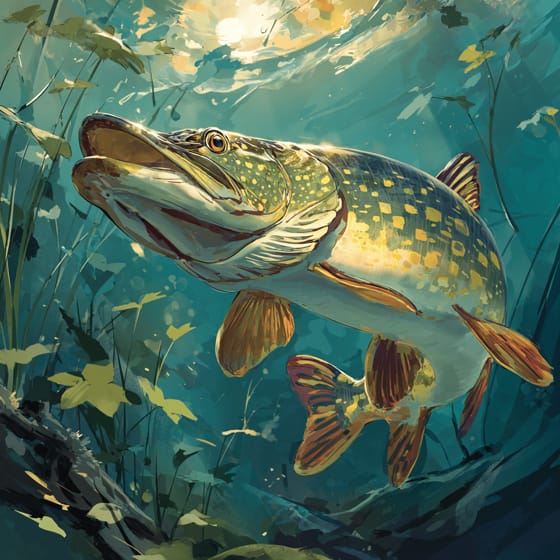
Esox lucius
Larger pike can prey on young sturgeon in freshwater.
Chironomus plumosus
Sturgeon forage for these midge larvae on river bottoms.
Gasterosteus aculeatus
Small fish like sticklebacks are part of the sturgeon's diet.
Wildlife encompasses all undomesticated animal and plant life existing in their natural habitats.
Piscivorous organisms are animals that primarily subsist on a diet of fish.
This trait signifies organisms belonging to a very old evolutionary group with ancestors dating back millions of years.
This trait characterizes organisms with an exceptionally long lifespan compared to others of their kind.

Coastal habitats are dynamic environments located along the interface between land and sea, influenced by tides, waves, and saltwater.

Freshwater habitats include non-saline aquatic environments such as rivers, lakes, ponds, and wetlands, vital for numerous species.

Aquatic habitats encompass environments where organisms live predominantly in water, including oceans, rivers, lakes, and wetlands.

Nocturnal animals are primarily active during the nighttime hours, typically resting or sleeping during the day.
Danger
2/5 · Low
When near water where sturgeons live, always stay safe and never try to touch them.
100-550 cm
10-1500 kg
50-150 years
Sturgeon are bottom-feeders, slurping up small creatures like insects, worms, and tiny fish from the riverbed.
20 km/h
Freshwater, Coastal areas
Foraging
200 m
Zoom in to split clusters and explore where this object has been snapped.
Recent snaps will appear here as new observations are added.