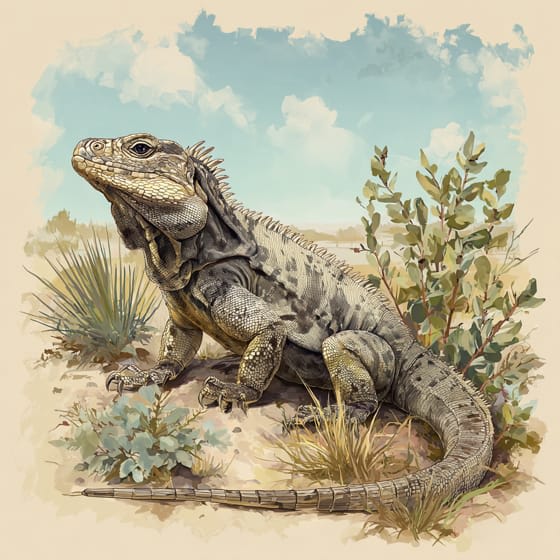





Spiny-tailed Iguana
Ctenosaura pectinata
The Spiny-tailed Iguana is known for its spiky tail and strong body. It loves to bask in the sun.
Habitat: Tropical forests and scrublands.
The Spiny-tailed Iguana is a robust lizard, typically gray to brownish-black, often with faint dark bands and yellowish or orange tints, especially on males. It has a distinctive long, keeled tail covered in rings of sharp spines that give it its name.
Category
ReptilesRarity
Rare
Danger
2/5 · Low
Snaps
Be the first to snap!
Their sharp claws help them climb trees and walls easily.
These lizards can stay underwater for over 30 minutes!
They like to bask on warm rocks to heat up their bodies.
Young iguanas are often bright green to blend with leaves.
Spiny-tailed Iguana has a spiny, keeled tail that helps them defend against predators by lashing it like a whip.
Spiny-tailed Iguana can dig complex burrows that helps them hide from danger and escape extreme temperatures.
Spiny-tailed Iguana can run up to 35 km/h because of strong legs, which helps them quickly escape predators.
These iguanas enjoy a mix of plants and insects, changing their menu as they grow up!
Age differences: Young iguanas eat more insects and spiders, while adults become mostly herbivorous.
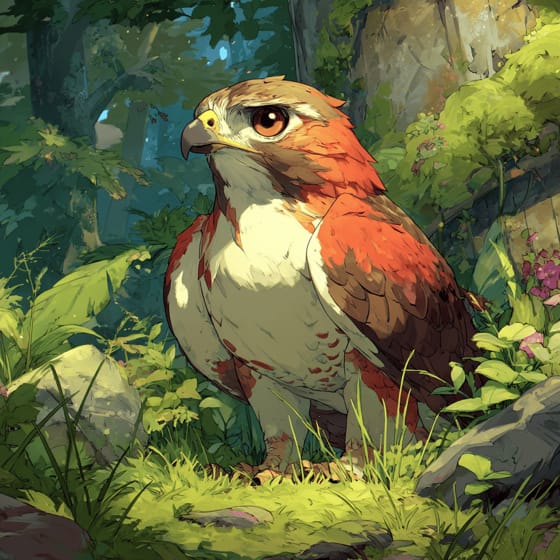
Buteo jamaicensis
Adults and juveniles are hunted from above.
Boa imperator
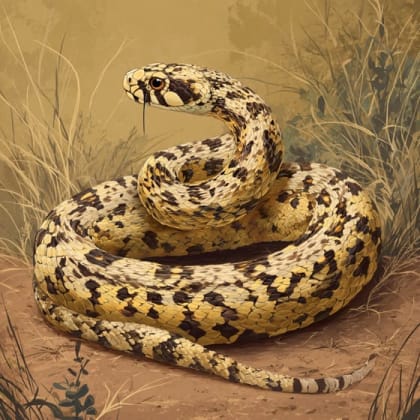
Large snakes prey on iguanas of various sizes.
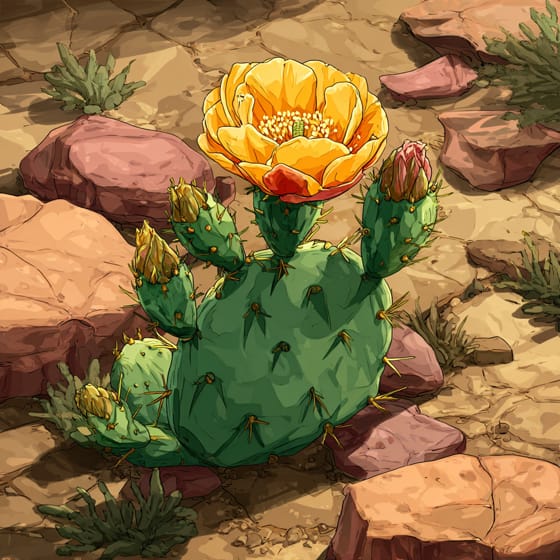
Opuntia ficus-indica
They eat the fruits and pads of this common plant.
Schistocerca nitens
Young iguanas often feed on these abundant insects.
Wildlife encompasses all undomesticated animal and plant life existing in their natural habitats.
Social animals live in organized groups, cooperating for survival benefits such as foraging, defense, and raising offspring.
This trait characterizes organisms whose diet consists entirely or primarily of plant material.
Thermoregulating organisms maintain a stable internal body temperature despite fluctuations in the external environment.

Possessing sharp, pointed projections or spines on the body or surface.

This habitat trait refers to species found in tropical rainforests, characterized by high annual rainfall, high biodiversity, and dense tree cover.

Diurnal animals are primarily active during daylight hours, typically resting or sleeping at night.
Danger
2/5 · Low
Look but don’t touch. Keep a safe distance and wash hands after exploring.
30-130 cm
0.5-2 kg
10-20 years
35 km/h
These iguanas enjoy a mix of plants and insects, changing their menu as they grow up!
Tropical forests and scrublands.
Foraging
10-30
Zoom in to split clusters and explore where this object has been snapped.
Recent snaps will appear here as new observations are added.