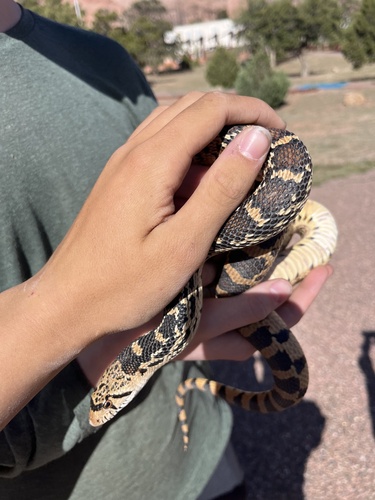
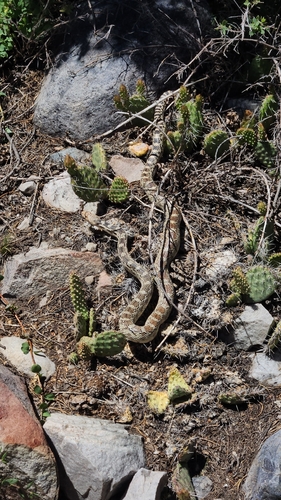
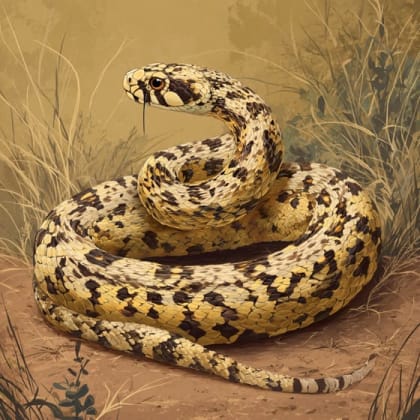
Gopher Snake
Pituophis catenifer
Gopher Snakes are often mistaken for rattlesnakes because of their color! They are friendly and help control the rodent population.
Habitat: Grasslands and open forests
The Gopher Snake is a large, powerful snake with a pointed snout. It has a base color of tan, yellow, or cream, covered with distinct dark brown or black blotches and keeled scales. This patterning can sometimes make it look like a rattlesnake.
Category
ReptilesRarity
Common
Danger
2/5 · Low
Snaps
50
Gopher Snakes are non-venomous, so they are harmless to humans!
Some Gopher Snakes can grow over 7 feet long, making them quite impressive!
Their scientific name, *Pituophis catenifer*, means 'pine snake chain-bearer' because of their markings.
These amazing snakes help farmers by eating lots of rodents that damage crops.
Gopher Snake can vigorously shake its tail against dry leaves, creating a rattling sound to scare away potential threats.
Gopher Snake uses its strong body to coil tightly around prey, constricting it until it can no longer breathe.
Gopher Snake has a unique pointed snout that helps it burrow into soft soil to find prey or shelter.
Gopher Snakes are fantastic hunters that love to eat small animals like rodents, birds, and their eggs!
.jpg&width=800)
Microtus californicus
A primary prey item, helping to control vole populations.
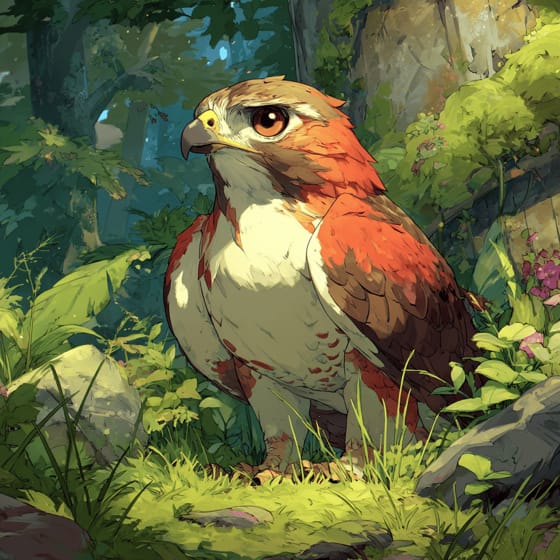
Buteo jamaicensis
Young Gopher Snakes are vulnerable to large raptors.
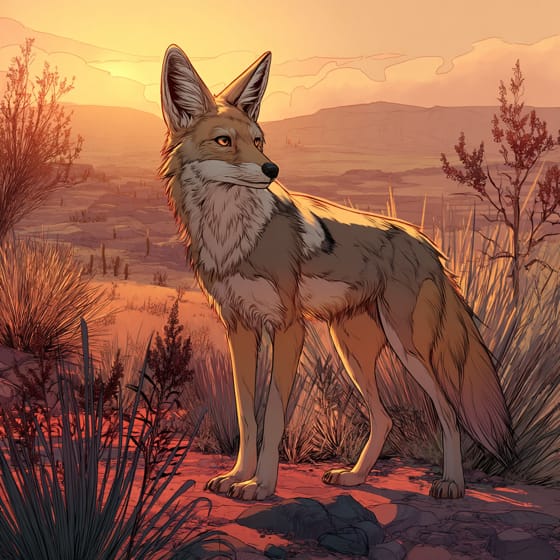
Canis latrans
Coyotes will prey on Gopher Snakes they encounter.

Spermophilus beecheyi
Preys on ground squirrels, often entering their burrows.
Wildlife encompasses all undomesticated animal and plant life existing in their natural habitats.
Grassland habitats are terrestrial biomes dominated by grasses and herbaceous plants, supporting a variety of grazing animals.
This trait characterizes organisms with an exceptionally long lifespan compared to others of their kind.
This trait identifies organisms whose diet consists entirely or primarily of animal tissue.

Nocturnal animals are primarily active during the nighttime hours, typically resting or sleeping during the day.
Danger
2/5 · Low
Look but don’t touch. Keep a safe distance and wash hands after exploring.
The easiest way to identify Gopher Snake is to use the Snappit nature identifier app.
90-210 cm
0.5-2.5 kg
10-15 years
4 km/h
Gopher Snakes are fantastic hunters that love to eat small animals like rodents, birds, and their eggs!
Grasslands and open forests
Ambush
Zoom in to split clusters and explore where this object has been snapped.
May 25, 2024
Navajo Nation Zoological and Botanical ParkPhoto attribution
(c) William Harmon, some rights reserved (CC BY)
License: CC BY 4.0 ↗
Image may be shown cropped inside the card frame.
Jul 1, 2023
Lehman Orchard and AqueductPhoto attribution
(c) Cristhian Mace, some rights reserved (CC BY)
License: CC BY 4.0 ↗
Image may be shown cropped inside the card frame.

California, US
You might spot California Poppy and Common Side-Blotched Lizard.
View guide →

California, US
You might spot Western Fence Lizard and California Brittlebush.
View guide →

California, US
You might spot Warrior's Plume and Purple Owl's-Clover.
View guide →

Oklahoma, US
You might spot Western Ratsnake and Spotted Chorus Frog.
View guide →

New Mexico, US
You might spot Pronghorn, Great-Tailed Grackle, and Redstem Stork's-Bill.
View guide →

California, US
You might spot Western Fence Lizard, Duck, and California Brittlebush.
View guide →
Take the discovery with you
Snap it with Snappit to identify it, learn what makes it special, and add the discovery to your collection.