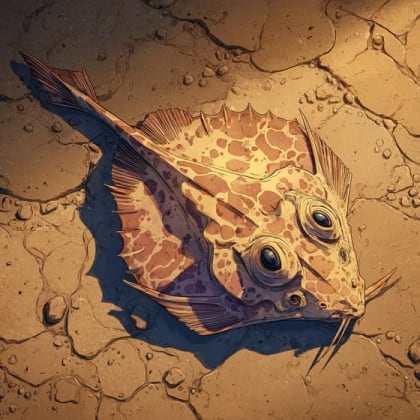
Tripod Fish
Ipnopidae
The Tripod Fish is a unique deep-sea creature with elongated fins that it uses like legs to stand on the ocean floor. It has a long, slender body and a pointed snout, making it a fascinating sight in the dark depths.
Habitat: Deep Sea
The Tripod Fish has a slender, eel-like body, typically brownish or grayish. Its most striking feature is three greatly elongated, rigid fins—two pelvic and one caudal—which act like stilts. Its small, degenerate eyes are located high on its head.
Category
FishRarity
Common
Danger
1/5 · Very low
Snaps
Be the first to snap!
Its pectoral fins are also highly modified to act like antennae!
These fish don't chase food; they patiently wait for it to drift by!
They can survive immense pressure, thousands of meters deep!
Tripod Fish live in areas where sunlight never, ever reaches!
Tripod Fish can stand perfectly still on the seafloor using their three extra-long fins because these modified fins act like stilts, helping them save energy and ambush prey.
Tripod Fish has sensitive pectoral fins that detect tiny vibrations in the water, helping them sense prey because their deep-sea habitat is pitch black and eyes are useless.
Tripod Fish can snatch unsuspecting prey that drifts close because its wide, upward-facing mouth is perfectly positioned to snap shut rapidly.
Tripod Fish are patient hunters, eating small critters that drift by in the deep sea.
Metridia lucens
These small crustaceans are a common meal for Tripod Fish.
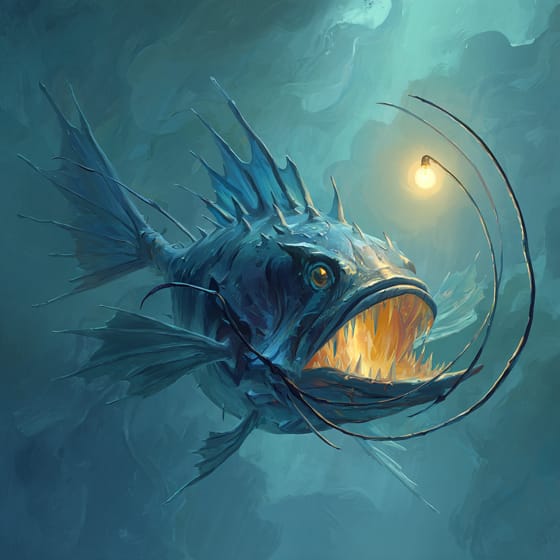
Chauliodus sloani
Larger deep-sea predators sometimes prey on Tripod Fish.
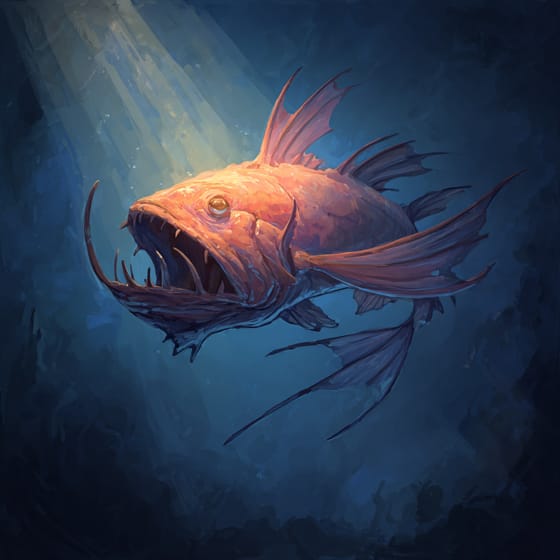
Anoplogaster cornuta
Another fearsome deep-sea hunter that might eat Tripod Fish.
Wildlife encompasses all undomesticated animal and plant life existing in their natural habitats.
Camouflaged describes organisms that possess coloring or patterns that allow them to blend into their environment.
Piscivorous organisms are animals that primarily subsist on a diet of fish.
This trait signifies organisms belonging to a very old evolutionary group with ancestors dating back millions of years.
Deep sea habitats are characterized by extreme pressure, darkness, and cold temperatures, supporting unique life forms below the sunlit zone.
Regenerative organisms possess the ability to regrow lost or damaged body parts, tissues, or organs.

Aquatic habitats encompass environments where organisms live predominantly in water, including oceans, rivers, lakes, and wetlands.

Nocturnal animals are primarily active during the nighttime hours, typically resting or sleeping during the day.
No aliases listed yet.
Danger
1/5 · Very low
Tripod Fish are not dangerous to humans, but they live in very deep waters where it's hard for people to explore.
20-120 cm
0.1-0.5 kg
10-20 years
Tripod Fish are patient hunters, eating small critters that drift by in the deep sea.
0.2 km/h
Deep Sea
Ambush
6000 m
Zoom in to split clusters and explore where this object has been snapped.
Recent snaps will appear here as new observations are added.