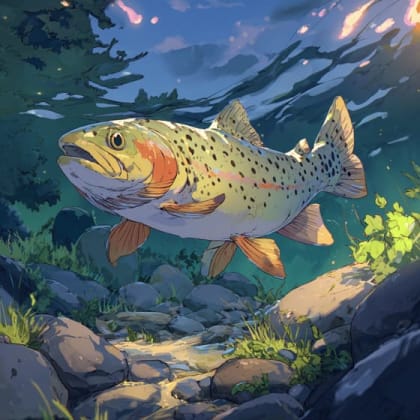

Viperfish
Chauliodus sloani
The Viperfish is a deep-sea predator with long, needle-like teeth and a glowing lure on its head to attract prey in the dark depths of the ocean.
Habitat: Deep Sea
The Viperfish has a long, slender, dark metallic body covered in light-producing organs called photophores. Its most striking feature is its disproportionately large mouth filled with incredibly long, needle-sharp fangs.
Category
FishRarity
Rare
Danger
2/5 · Low
Snaps
Be the first to snap!
Its huge fangs are so big, they curve *outside* its mouth even when closed!
Some viperfish migrate hundreds of meters up and down the ocean daily.
Their eyes are specially adapted to spot faint bioluminescent flashes in the dark.
Viperfish have a tiny light organ on a fin ray that acts like a fishing lure!
Viperfish can glow with built-in lights because of special organs called photophores that help them attract prey in the deep, dark ocean.
Viperfish has extremely long, sharp fangs that help them trap and hold onto struggling prey, preventing escape in the pitch black.
Viperfish can swallow prey larger than its head because of a hinged jaw and stretchy stomach, helping them eat big meals when they find them.
Viperfish can live in extreme depths because of specialized adaptations that help them withstand immense ocean pressure.
A fierce deep-sea hunter that eats other fish and small ocean creatures with its massive fangs.
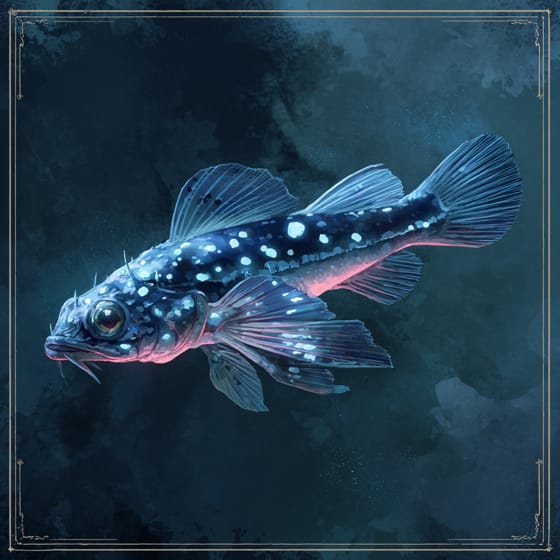
Myctophum punctatum
A primary food source in the deep sea.
Stomias boa
Preys on other smaller deep-sea fish.
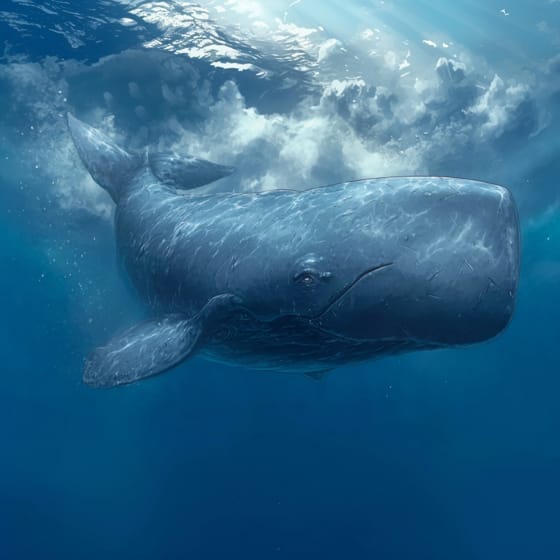
Physeter macrocephalus
Occasionally eaten by these deep-diving predators.
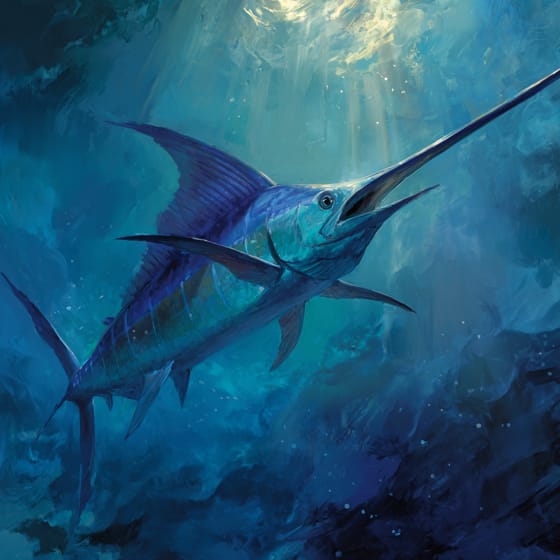
Xiphias gladius
Larger fish like swordfish can prey on them.
Piscivorous organisms are animals that primarily subsist on a diet of fish.
An ambush predator hunts by patiently waiting and concealing itself, then launching a sudden attack when unsuspecting prey comes within range.
This trait signifies organisms belonging to a very old evolutionary group with ancestors dating back millions of years.
Deep sea habitats are characterized by extreme pressure, darkness, and cold temperatures, supporting unique life forms below the sunlit zone.

This trait characterizes organisms with an exceptionally long lifespan compared to others of their kind.

Aquatic habitats encompass environments where organisms live predominantly in water, including oceans, rivers, lakes, and wetlands.

Pertaining to organisms that emit light through bioluminescence or fluorescence.

Nocturnal animals are primarily active during the nighttime hours, typically resting or sleeping during the day.

Venomous organisms produce toxins that are injected into another animal, typically through a bite or sting.
Danger
2/5 · Low
Viperfish live in the deep sea and are not encountered by people. They are not dangerous to humans.
The easiest way to identify Viperfish is to use the Snappit nature identifier app.
30-60 cm
0.1-0.5 kg
15-30 years
A fierce deep-sea hunter that eats other fish and small ocean creatures with its massive fangs.
3 km/h
Deep Sea
Ambush
Zoom in to split clusters and explore where this object has been snapped.
Recent snaps will appear here as new observations are added.
Take the discovery with you
Snap it with Snappit to identify it, learn what makes it special, and add the discovery to your collection.