

African Black Beetle
heteronychus arator
The African Black Beetle (Heteronychus arator), sometimes known as the black lawn beetle, is a stout, glossy scarab beetle that is infamous among gardeners, turf managers, and farmers alike. Originally native to southern Africa, this resilient insect has hitchhiked its way across the globe, becoming a well-established resident—and frequent pest—in countries like Australia and New Zealand. While its voracious appetite for grassroots and stems often puts it at odds with humans maintaining pristine lawns or agricultural crops, the beetle is an undeniable marvel of adaptability. During warm summer evenings, these beetles are famous for taking to the skies in impressive, buzzing swarms, drawn to the bright glow of streetlights and porch lamps. Whether considered a fascinating coleopteran or a turf-destroying menace, the African Black Beetle showcases the incredible ability of insects to colonize and thrive in human-altered landscapes.
Habitat: Commonly found in grasslands, pastures, turf, golf courses, and agricultural fields where grass roots and organic matter are plentiful in the soil.
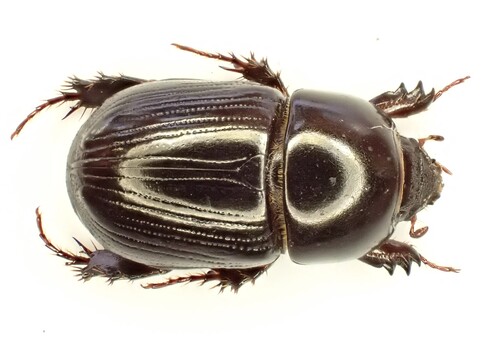
Adults are robust, oval-shaped, and shiny black, measuring about 12 to 15 millimeters in length. Upon close inspection, their hardened forewings (elytra) feature distinct, parallel longitudinal grooves running down their backs. Their front legs are modified with strong, tooth-like projections adapted perfectly for digging through tough soil. In their larval stage, they appear as classic scarab 'white grubs'—soft-bodied, C-shaped, creamy white with tan or orange-brown heads, and a distinct dark grey tinge visible at the rear end of their abdomen.
Category
InsectsRarity
Common
Danger
1/5 · Very low
Snaps
Be the first to snap!
African Black Beetles are notoriously attracted to white and UV lights, often causing them to 'rain down' around streetlamps on hot summer nights.
Despite their small size, a dense infestation of their larvae can completely detach a lawn from its roots, allowing the dead turf to be rolled back like a carpet.
They are considered one of the most damaging insect pests to the dairy and agricultural industries in New Zealand and Australia.
When handled or threatened, adult beetles often play dead, tucking their legs tight against their bodies and dropping into the grass to avoid detection.
The beetle's front legs are modified with heavy, tooth-like spikes that act like miniature shovels, allowing it to rapidly burrow into the soil.
Adults coordinate large, localized mating and dispersal flights during warm, humid nights, overwhelming local predators by their sheer numbers.
The larvae possess powerful jaws designed to sever and chew through tough, fibrous grassroots, enabling them to survive entirely underground.
Larvae feed extensively on grass roots and soil organic matter, while adults target the stems of young plants at or just beneath the soil surface.
Age differences: Larvae primarily eat roots and decaying organic matter underground, whereas adults emerge to feed on plant stems and crowns near the surface.
Gymnorhina tibicen
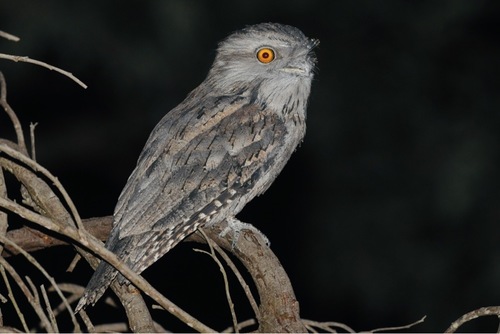
Birds actively forage for grubs and adult beetles by probing turf and pastures.
Cenchrus clandestinus
A highly preferred food source and habitat for the beetle in its introduced range.
Heterorhabditis zealandica
Microscopic worms used as biological control to infect and kill the larvae underground.
No trait badges are assigned for this object yet.
No aliases listed yet.
Collections for this object will appear here as more themes are added.
Danger
1/5 · Very low
No special safety notes yet.
The easiest way to identify African Black Beetle is to use the Snappit nature identifier app.
1 cm
2-3 cm
0.0001-0.0003 kg
0-1 years
Larvae feed extensively on grass roots and soil organic matter, while adults target the stems of young plants at or just beneath the soil surface.
Commonly found in grasslands, pastures, turf, golf courses, and agricultural fields where grass roots and organic matter are plentiful in the soil.
Foraging
Zoom in to split clusters and explore where this object has been snapped.
Recent snaps will appear here as new observations are added.
Take the discovery with you
Snap it with Snappit to identify it, learn what makes it special, and add the discovery to your collection.









.jpg&width=800)




