


Australian Umbrella Tree
heptapleurum actinophyllum
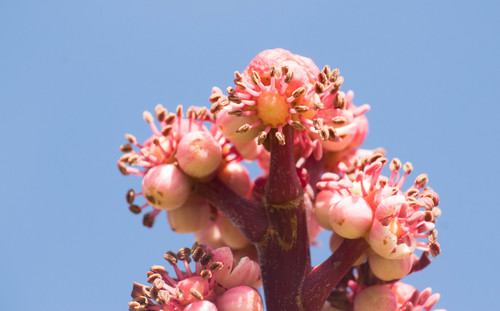
The Australian Umbrella Tree is an iconic tropical evergreen tree renowned for its lush foliage and dramatic flowering display. Native to the damp rainforests of northern Australia and New Guinea, this fast-growing species is famous for its unique palmately compound leaves that radiate outwards like the spokes of an umbrella. In the wild, it can begin life as an epiphyte, growing high in the canopy of host trees before sending aerial roots down to earth. During its blooming season, it erupts with magnificent, radiating spikes of deep red flowers that resemble the tentacles of an octopus, earning it the alternative moniker 'Octopus Tree'.
Habitat: Found in humid tropical rainforests, wet sclerophyll forests, and gallery forests, often starting its life cycle epiphytically in tree crotches.
This medium-to-large evergreen tree typically reaches heights of 10 to 15 meters, featuring a single trunk or multiple slender trunks. Its outstanding feature is its glossy, deep green palmately compound leaves, each composed of 7 to 16 leaflets arranged in a circular umbrella shape. At the tree's crown, spectacular inflorescences emerge as massive, radiating clusters of bright red flowers on spikes up to 2 meters long, which eventually mature into small, dark purple-to-black round fruits.
Category
PlantsRarity
Common
Danger
1/5 · Very low
Snaps
Be the first to snap!
Despite its beauty, it is considered an invasive weed in Hawaii and Florida, where its aggressive roots can damage plumbing and native ecosystems.
In humid environments, it can grow as an air-dwelling epiphyte, with its seeds often deposited high up in trees by birds.
Its spectacular flower spikes can grow up to 2 meters long, resembling the red arms of an upside-down octopus.
Can germinate high in the tree canopy as an epiphyte, eventually sending strong roots downward to ground and outcompete its host tree for resources.
Produces massive flowering spikes packed with abundant nectar, attracting a high volume of diverse pollinators to ensure cross-pollination.
Exhibits exceptional juvenile growth rates, allowing it to quickly push through the understory of dense rainforests to capture sunlight.
As a photoautotroph, the Australian Umbrella Tree utilizes chlorophyll to capture solar energy, converting carbon dioxide and water into vital sugars while absorbing minerals through its root system.
Age differences: In its early epiphytic stage, it relies on aerial roots to absorb moisture and nutrients from tree-crotch debris before establishing ground roots.
Pteropus conspicillatus
Feeds on nectar from red flower spikes and disperses seeds through digestion.

Trichoglossus moluccanus
Feeds heavily on the copious nectar of the octopus-like flower clusters, assisting in pollination.
Casuarius casuarius
Consumes the fallen dark purple drupes on the forest floor, acting as an effective seed disperser.
No trait badges are assigned for this object yet.
No aliases listed yet.
Collections for this object will appear here as more themes are added.
Danger
1/5 · Very low
No special safety notes yet.
Start with the whole plant, then compare leaf arrangement, leaf edges, stems and any flowers or fruit. Opposite leaves grow in pairs; alternate leaves come one at a time along the stem. These details tell you far more together than a single green leaf does. Plant Identifier: upload a photo and compare the visible details.
300+ cm
50+ years
As a photoautotroph, the Australian Umbrella Tree utilizes chlorophyll to capture solar energy, converting carbon dioxide and water into vital sugars while absorbing minerals through its root system.
Found in humid tropical rainforests, wet sclerophyll forests, and gallery forests, often starting its life cycle epiphytically in tree crotches.
Zoom in to split clusters and explore where this object has been snapped.
Recent snaps will appear here as new observations are added.
Take the discovery with you
Snap it with Snappit to identify it, learn what makes it special, and add the discovery to your collection.


















