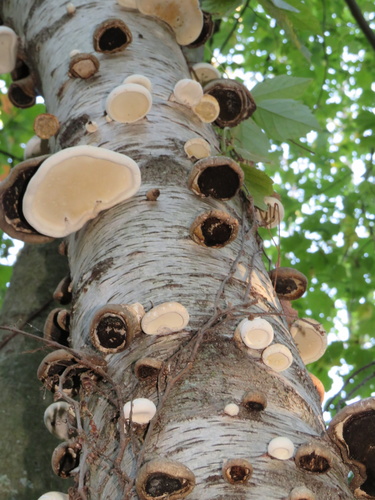


Birch Polypore
fomitopsis betulina
The Birch Polypore is an incredibly common bracket fungus that acts as a quiet sentinel of northern forests. Growing almost exclusively on birch trees, this pale, cushion-shaped mushroom begins its life as a parasite, slowly weakening its host, before transitioning into a saprobe that decomposes the dead wood. For thousands of years, humans have held a deep relationship with this fungus, utilizing its versatile corky flesh for medicine, bandage-making, and even tool sharpening. Whether you are a bushcraft enthusiast or a casual hiker, encountering this silent forest dweller is a testament to the complex, cyclical processes of forest decay and rebirth.
Habitat: Found growing almost exclusively on living, dying, or dead birch trees in temperate and boreal forests.
Characterized by its smooth, hoof-shaped or kidney-shaped bracket, the Birch Polypore lacks a distinct stem and fuses directly to birch bark. Its upper surface is initially white to pale cream, turning a dull greyish-brown as it matures, and features a rounded, incurved edge. The underside consists of a flat, white pore surface that bruises slightly yellow or brown when scratched. Individual brackets typically range from 5 to 25 centimeters in width and have a tough, rubbery texture when fresh, which dries to a corky consistency.
Category
FungiRarity
Common
Danger
1/5 · Very low
Snaps
6
A piece of birch polypore was found in the gear of Ötzi the Iceman, a 5,300-year-old mummy, likely carried for its medicinal properties.
Because its velvety, corky interior smolders very slowly without catching fire, it was historically used to transport embers from campfire to campfire.
Historically, barbers used dried strips of this fungus to sharpen their razors, giving it the common nickname of razor strop fungus.
Produces specialized enzymes that selectively break down the cellulose and hemicellulose in birch wood, causing a rapid brown rot that returns nutrients to the soil.
The inner flesh can be peeled into sterile, flexible strips that naturally stop bleeding, act as antiseptic bandages, and assist in wound healing.
Synthesizes bioactive molecules like piptamine, which protect the fruiting body from bacterial infections and competing fungal species.
As a parasitic and saprophytic organism, it absorbs nutrients directly from birch wood by secreting powerful wood-decaying enzymes.
Age differences: Begins as a parasite feeding on living birch tissues, then transitions to a saprobe feeding on dead wood after the tree dies.

Betula pendula
Serves as the host tree where the fungus establishes its mycelium and produces its fruiting brackets.
Cis bilamellatus
The larvae of this tiny beetle tunnel into and feed upon the corky bracket of the fungus.
Hypocrea pulvinata
A specialized mycoparasitic fungus that grows as a yellow cushion over the old pores of the birch polypore.
No trait badges are assigned for this object yet.
No aliases listed yet.
Collections for this object will appear here as more themes are added.
Danger
1/5 · Very low
No special safety notes yet.
Compare the cap shape, the underside, the stem and base, and whether the fungus grows on wood or soil. Some fungi have gills, others pores or teeth. A cap seen only from above often hides the most useful features. Mushroom Identifier: upload a photo and compare the visible details.
5-25 cm
0.1-1.5 kg
1 years
As a parasitic and saprophytic organism, it absorbs nutrients directly from birch wood by secreting powerful wood-decaying enzymes.
Found growing almost exclusively on living, dying, or dead birch trees in temperate and boreal forests.
Absorption
Zoom in to split clusters and explore where this object has been snapped.

New York, US
You might spot American White Waterlily, Buttonbush, and Common Milkweed.
View guide →

Connecticut, US
You might spot Osprey, Diamondback Terrapin, and Monarch.
View guide →

Pennsylvania, US
You might spot Downy Rattlesnake Plantain and Striped Wintergreen.
View guide →

Pennsylvania, US
You might spot Steeplebush, Elk, and Eastern Newt.
View guide →

Massachusetts, US
You might spot Striped Wintergreen, Mapleleaf Viburnum, and Duck.
View guide →
Take the discovery with you
Snap it with Snappit to identify it, learn what makes it special, and add the discovery to your collection.