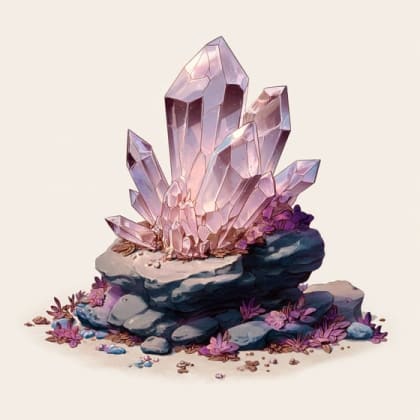



Chalcopyrite
Chalcopyrite is a shiny mineral that looks like gold but has a brassy yellow color. It is often found near copper deposits and can be used to make beautiful jewelry and decorations.
The Chalcopyrite has a distinctive brass-yellow to golden-yellow color. It often develops a vibrant iridescent tarnish, making it gleam with rainbow hues of blue, purple, and red. This mineral looks somewhat like gold but is usually darker and more brittle.
Category
MineralRarity
Rare
Danger
1/5 · Very low
Snaps
Be the first to snap!
Ancient civilizations used Chalcopyrite to make tools and ornaments thousands of years ago!
Copper extracted from Chalcopyrite helps make our phones and computers work!
Its name combines 'chalkos' (copper) and 'pyrites' (strike fire) from Greek!
Unlike real gold, Chalcopyrite is brittle and will shatter if struck!
Chalcopyrite has a high copper content, making it the most important ore for producing the essential metal copper.
Chalcopyrite can develop an amazing iridescent tarnish when exposed to air, creating a beautiful rainbow sheen!
Chalcopyrite has a relatively high specific gravity, making it feel surprisingly heavy for its size.
Colorful describes organisms or objects displaying a wide range of bright and distinct colors.
Metallic refers to substances, materials, or objects possessing properties characteristic of metals, such as luster and conductivity.
Metallic luster describes a mineral's appearance when reflecting light, resembling polished metal, often opaque.
A gemstone is a piece of mineral crystal which, when cut and polished, is used to make jewelry or other adornments.

Crystalline describes a mineral or rock composed of crystals, often exhibiting a regular atomic structure and geometric external form.
Danger
1/5 · Very low
Chalcopyrite is a mineral and safe to handle, but it's best to enjoy its beauty without touching it.
The easiest way to identify Chalcopyrite is to use the Snappit nature identifier app.
brass-yellow, golden-yellow, iridescent tarnish
3.5
metallic
4.2
tetragonal
Zoom in to split clusters and explore where this object has been snapped.
Recent snaps will appear here as new observations are added.
Take the discovery with you
Snap it with Snappit to identify it, learn what makes it special, and add the discovery to your collection.