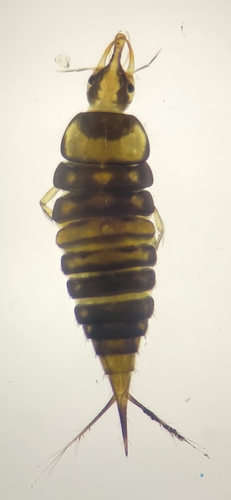


Cherrystone Beetle
hyphydrus ovatus
The Cherrystone Beetle, Hyphydrus ovatus, is a fascinating member of the Dytiscidae family, commonly known as diving beetles. This small, aquatic insect spends most of its life submerged in freshwater habitats, playing a significant role in the food web as a predator of smaller invertebrates. Its distinctive compact, broadly oval and strongly convex body shape, reminiscent of a cherrystone, allows it to move efficiently through water with minimal drag. Beyond its aquatic prowess, this beetle also possesses the remarkable ability to take to the air, using flight for dispersal to new water bodies, a crucial adaptation for survival in transient or ephemeral environments.
Habitat: This species is primarily found in still or slow-moving freshwater environments, including ponds, ditches, shallow lakes, and the vegetated margins of slow rivers and wetlands, especially where there is abundant aquatic vegetation.
Measuring typically between 4 to 5 millimeters in length, Hyphydrus ovatus has a highly characteristic, broadly oval and strongly convex body, giving it its 'cherrystone' common name. Its dorsal surface is smooth and often exhibits a reddish-brown to dark brown or almost black coloration, sometimes with subtle lighter markings. The head is relatively small, and the antennae are short and inconspicuous. The legs are short and adapted for swimming, with the hind legs flattened and fringed with hairs for powerful propulsion through water.
Category
InsectsRarity
Common
Danger
1/5 · Very low
Snaps
Be the first to snap!
Both the adult beetles and their larvae are active and efficient predators in their aquatic habitats, playing a role in controlling populations of smaller invertebrates.
Despite being a proficient swimmer, the Cherrystone Beetle can readily fly, often leaving its water body at night to seek out new ponds or escape drying conditions, showcasing its adaptability to changing environments.
It gets its common name 'Cherrystone Beetle' from its distinctly oval, convex, and smooth body shape, which closely resembles a cherry pit.
To breathe underwater, this beetle cleverly traps a bubble of air under its hardened wing covers, using it like a portable oxygen tank and a physical gill to absorb dissolved oxygen from the surrounding water.
The Cherrystone Beetle carries a bubble of air under its wing cases (elytra) when submerged. This trapped air acts as a physical gill, allowing it to extract dissolved oxygen from the water and extend its time underwater before needing to surface.
Its highly convex and streamlined oval body significantly reduces drag in water. This specialized shape, coupled with its paddle-like hind legs, enables efficient and swift movement through aquatic environments for hunting and escaping predators.
Despite its predominantly aquatic lifestyle, Hyphydrus ovatus possesses fully functional wings and can fly. This ability is crucial for colonizing new or ephemeral water bodies when its current habitat becomes unsuitable or dries up, often occurring at night.
The Cherrystone Beetle is an active aquatic predator, both in its adult and larval stages, feeding on a variety of smaller invertebrates found within its freshwater habitat.
Various species
Preyed upon by small fish that inhabit the same freshwater bodies.
Daphnia pulex
Larval and adult forms prey on smaller aquatic invertebrates.
Elodea canadensis
Provides habitat, shelter, and attachment sites for eggs within the aquatic environment.
Chironomus plumosus
Feeds on a variety of small aquatic insect larvae in its habitat.
No trait badges are assigned for this object yet.
No aliases listed yet.
Collections for this object will appear here as more themes are added.
Danger
1/5 · Very low
No special safety notes yet.
Look for hard wing covers meeting in a line down the back, then compare the antennae, body shape, legs and markings. Metallic colors shift a lot with lighting. Beetle Identifier: upload a photo and compare the visible details.
0 cm
0-1 cm
0 kg
1-2 years
0 km/h
The Cherrystone Beetle is an active aquatic predator, both in its adult and larval stages, feeding on a variety of smaller invertebrates found within its freshwater habitat.
This species is primarily found in still or slow-moving freshwater environments, including ponds, ditches, shallow lakes, and the vegetated margins of slow rivers and wetlands, especially where there is abundant aquatic vegetation.
Zoom in to split clusters and explore where this object has been snapped.
Recent snaps will appear here as new observations are added.
Take the discovery with you
Snap it with Snappit to identify it, learn what makes it special, and add the discovery to your collection.