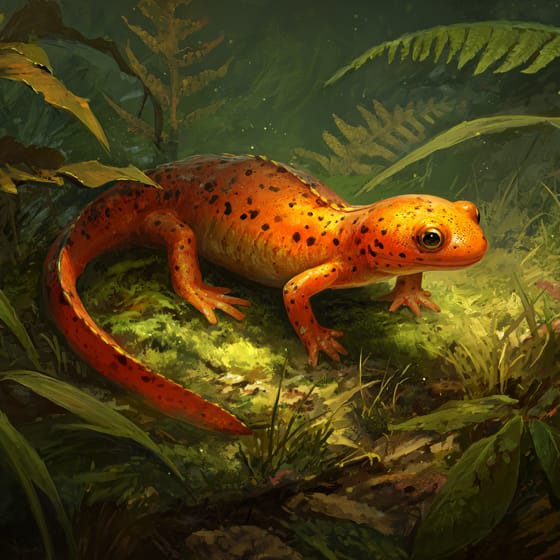





Eastern Newt
Notophthalmus viridescens
The Eastern Newt is a small, bright orange newt that loves the water. They can be very shy and like to hide among plants.
Habitat: Freshwater lakes and ponds
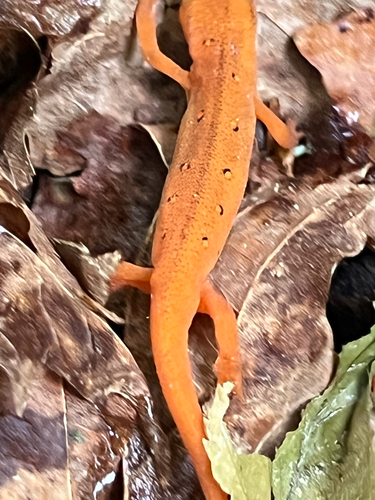
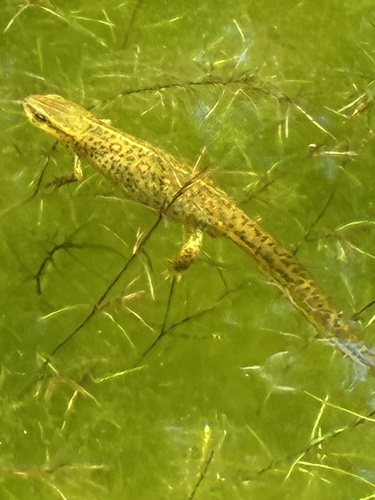
The Eastern Newt has a slender body, ranging from olive green to brownish, with a yellow belly. Its most distinctive feature is a row of bright red-orange spots bordered in black along its back. The terrestrial "red eft" stage is vividly orange-red with similar spots and rough skin.
Category
AmphibiansRarity
Common
Danger
2/5 · Low
Snaps
174
Eastern Newts can live up to 15 years, much longer than many amphibians!
Sometimes, many newts hibernate together in muddy pond bottoms!
Their bright orange 'red eft' stage warns predators they are toxic!
They return to the same pond to breed, even after years on land!
Eastern Newt has a powerful toxin in its skin that helps protect it from most predators, making them too risky to eat.
Eastern Newt can change through three life stages – larva, land eft, and aquatic adult – helping them survive in various habitats.
These newts are small hunters, munching on tiny bugs and worms found in water and on land.
Age differences: Larvae eat microscopic organisms, efts eat terrestrial invertebrates, and adults primarily eat aquatic invertebrates.
Thamnophis sirtalis
Snakes are one of few predators that can tolerate their toxins.

Procyon lotor
A generalist predator that will consume newts if found.
Chironomus plumosus
Adult newts prey on these common aquatic insect larvae.
Helisoma trivolvis
A common aquatic snail species eaten by adult newts.
Wildlife encompasses all undomesticated animal and plant life existing in their natural habitats.
Characterized by having toes connected by a membrane, typically aiding in swimming.
Social animals live in organized groups, cooperating for survival benefits such as foraging, defense, and raising offspring.
This trait identifies organisms whose diet consists entirely or primarily of animal tissue.

Freshwater habitats include non-saline aquatic environments such as rivers, lakes, ponds, and wetlands, vital for numerous species.

Regenerative organisms possess the ability to regrow lost or damaged body parts, tissues, or organs.

Nocturnal animals are primarily active during the nighttime hours, typically resting or sleeping during the day.
Danger
2/5 · Low
Look but don’t touch. Keep a safe distance and wash hands after exploring.
The easiest way to identify Eastern Newt is to use the Snappit nature identifier app.
6.5-14 cm
0.001-0.005 kg
2-15 years
0.2 km/h
These newts are small hunters, munching on tiny bugs and worms found in water and on land.
Freshwater lakes and ponds
Foraging
Zoom in to split clusters and explore where this object has been snapped.
Jun 18, 2026
Riverton Historic DistrictPhoto attribution
no rights reserved
License: CC0 1.0 ↗
Image may be shown cropped inside the card frame.
Jun 5, 2026
Bernheim Forest and ArboretumPhoto attribution
(c) Anne H. Proffitt, some rights reserved (CC BY)
License: CC BY 4.0 ↗
Image may be shown cropped inside the card frame.
May 26, 2026
CheshamPhoto attribution
(c) Jaime McGuigan, some rights reserved (CC BY)
License: CC BY 4.0 ↗
Image may be shown cropped inside the card frame.

Pennsylvania, US
You might spot Pinesap, Great Rhododendron, and Mountain Laurel.
View guide →

Massachusetts, US
You might spot Eastern Newt, Purple Pitcher Plant, and Hobblebush.
View guide →

Pennsylvania, US
You might spot Large Yellow Underwing and Eastern Black Carpenter Ant.
View guide →

Maine, US
You might spot American Bullfrog and Three-Toothed Cinquefoil.
View guide →

New Hampshire, US
You might spot Eastern Red-Backed Salamander and Eastern Newt.
View guide →

Massachusetts, US
You might spot Mountain Laurel, Azure Bluet, and Partridgeberry.
View guide →
Take the discovery with you
Snap it with Snappit to identify it, learn what makes it special, and add the discovery to your collection.










.JPG&width=800)




.jpg&width=800)

