





Echinacea
Echinacea purpurea
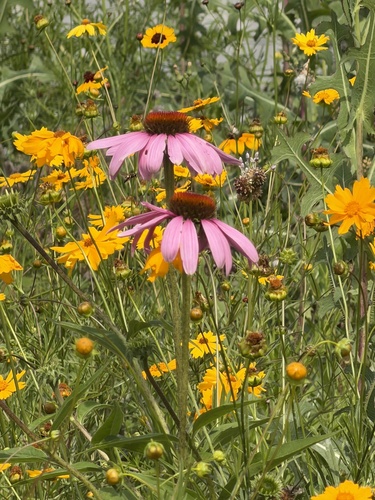
Echinacea, also known as coneflower, has bright purple petals that look like little umbrellas! Bees and butterflies love to visit them in gardens.
Habitat: Open fields and gardens
The Echinacea has large, daisy-like flowers with distinctive cone-shaped centers and prominent, often purple or pink ray petals that droop downwards slightly. Its sturdy, upright stems support vibrant blooms.
Category
PlantsRarity
Common
Danger
1/5 · Very low
Snaps
15
Butterflies and bees absolutely LOVE its sweet nectar!
Echinacea's name comes from Greek for 'hedgehog' because of its prickly middle!
Its spiky center feels like a tiny hedgehog's back!
Some Native American tribes used it for hundreds of years as traditional medicine!
Echinacea produces special compounds that support the immune system, helping animals and humans fight off illness.
Echinacea displays bright petals and a nectar-rich cone, which acts like a glowing landing strip for insects.
Echinacea develops deep taproots that allow it to reach water, helping it survive long dry spells.
Apis mellifera
Collects nectar and pollen.
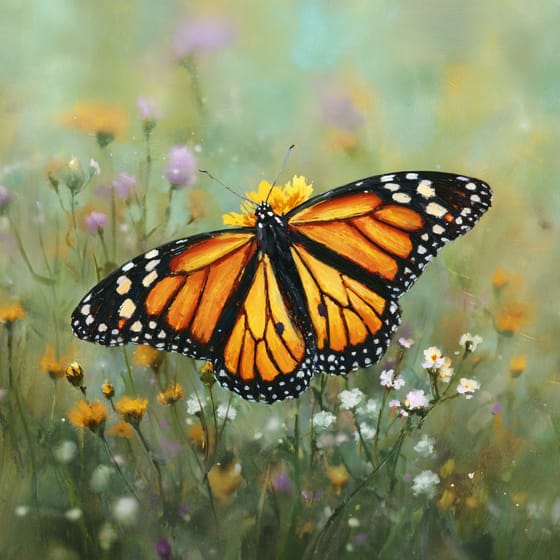
Danaus plexippus
Sips nectar, spreading pollen.
Bombus bimaculatus
Buzzes flowers for nectar.
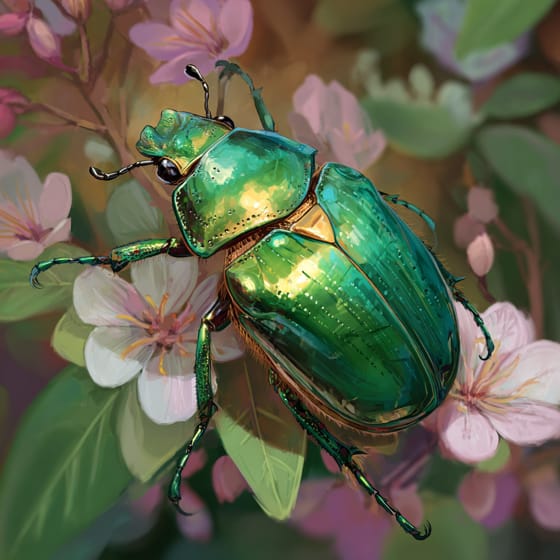
Popillia japonica
Chews on petals and leaves.
Deciduous plants periodically shed all their leaves, typically during autumn or dry seasons.
Medicinal plants possess chemical compounds that can be used for therapeutic purposes to treat illnesses or maintain health.
Grassland habitats are terrestrial biomes dominated by grasses and herbaceous plants, supporting a variety of grazing animals.
Describes plants that are particularly attractive and beneficial to a wide range of pollinating organisms.
Danger
1/5 · Very low
Explore with care and ask an adult if you’re unsure what to do.
The easiest way to identify Echinacea is to use the Snappit nature identifier app.
60-120 cm
30-60 cm
7-15 cm
Summer to fall
Yes
None
Perennial
Zoom in to split clusters and explore where this object has been snapped.
Jun 5, 2026
Georgia Institute of Technology Historic DistrictPhoto attribution
(c) novvictan, some rights reserved (CC BY)
License: CC BY 4.0 ↗
Image may be shown cropped inside the card frame.

New York, US
You might spot Rock Pigeon, American Robin, and Spotted Lanternfly.
View guide →
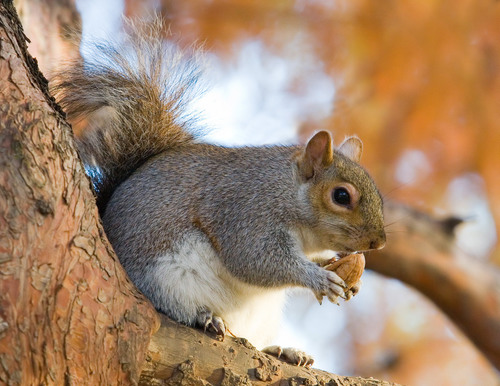
Georgia, US
You might spot Eastern Gray Squirrel, Domestic Cat, and American Robin.
View guide →

Georgia, US
You might spot Joro Spider, American Sweetgum, and American Tuliptree.
View guide →

Georgia, US
You might spot Eastern Gray Squirrel, Domestic Cat, and Anole.
View guide →

New York, US
You might spot Rock Pigeon, House Sparrow, and Eastern Gray Squirrel.
View guide →

Tennessee, US
You might spot American Robin and Eastern Gray Squirrel.
View guide →
Take the discovery with you
Snap it with Snappit to identify it, learn what makes it special, and add the discovery to your collection.









.jpg&width=800)



_001.jpg&width=800)




