





Japanese Beetle
Popillia japonica
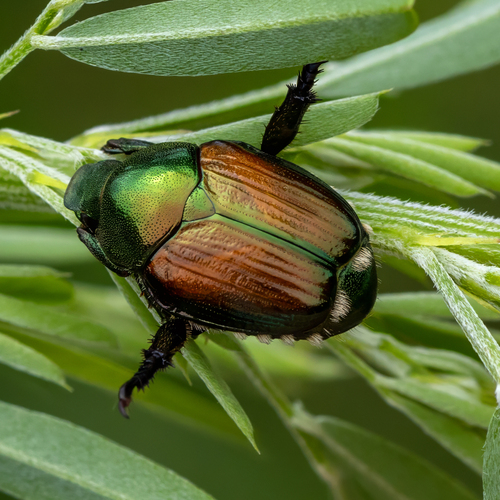
Japanese Beetles are shiny green and bronze beetles. They love to munch on leaves and flowers in gardens!
Habitat: Gardens and fields
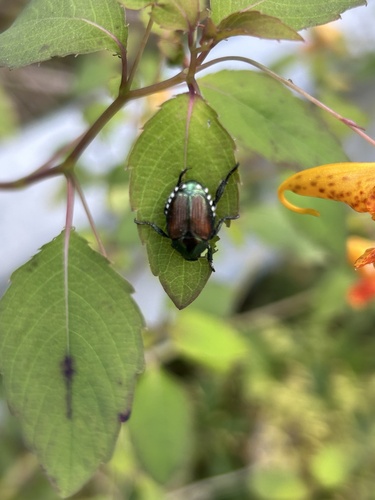
The Japanese Beetle has a shiny, iridescent metallic green head and thorax. Its wing covers are coppery-brown, and it features five distinct patches of white hair along each side of its abdomen, with two more at the tip, making it visually unique.
Category
InsectsRarity
Common
Danger
2/5 · Low
Snaps
93
A single female Japanese beetle can lay up to 60 eggs in the soil during her short summer lifespan!
Japanese beetle grubs live underground for months, happily munching on grass roots before they become adult beetles.
These beetles were first accidentally brought to America hidden in a shipment of iris bulbs in 1916!
They can skeletonize leaves, eating only the soft parts and leaving behind just the veins, making plants look like lace!
Japanese Beetle can devour a wide variety of plants using powerful chewing mouthparts that help them feed quickly.
Japanese Beetle has special scent glands that release pheromones, helping them attract many other beetles to new food sources.
Japanese Beetle can fly swiftly with strong wings, allowing them to rapidly move between plants or escape from threats.
These tiny plant-eaters munch on leaves, flowers, and fruits, causing damage to many different plants.
Age differences: Larvae (grubs) live underground, eating plant roots, while adults feed on leaves, flowers, and fruits above ground.
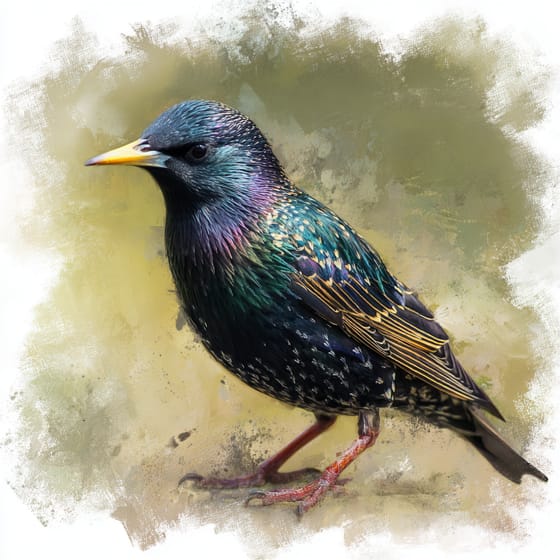
Sturnus vulgaris
Adult beetles are a common food source for these adaptable birds.
Tiphia vernalis
Wasp larvae grow inside and consume Japanese beetle grubs.
Rosa gallica
Adult beetles feed heavily on rose leaves and flowers, causing damage.

Zea mays
Beetles chew on corn silk, which can prevent successful pollination.
Wildlife encompasses all undomesticated animal and plant life existing in their natural habitats.
Social animals live in organized groups, cooperating for survival benefits such as foraging, defense, and raising offspring.
Colorful describes organisms or objects displaying a wide range of bright and distinct colors.
This trait characterizes organisms whose diet consists entirely or primarily of plant material.

Diurnal animals are primarily active during daylight hours, typically resting or sleeping at night.

Describes organisms that transfer pollen, enabling the fertilization and reproduction of plants.
Danger
2/5 · Low
Do not touch or pick up. Some insects sting or bite. Ask an adult for help.
The easiest way to identify Japanese Beetle is to use the Snappit nature identifier app.
12-15 mm
8-11 mm
30-60 days
10 km/h
These tiny plant-eaters munch on leaves, flowers, and fruits, causing damage to many different plants.
Gardens and fields
Foraging
Zoom in to split clusters and explore where this object has been snapped.
Jun 20, 2026
Fairlie-PoplarPhoto attribution
(c) Dan Vickers, some rights reserved (CC BY)
License: CC BY 4.0 ↗
Image may be shown cropped inside the card frame.
Sep 14, 2025
Stockbridge Common Historic DistrictPhoto attribution
(c) Marina, some rights reserved (CC BY)
License: CC BY 4.0 ↗
Image may be shown cropped inside the card frame.

Tennessee, US
You might spot House Sparrow, Northern Mockingbird, and Gulf Fritillary.
View guide →

South Carolina, US
You might spot Anole, Green Treefrog, and Eastern Gray Squirrel.
View guide →

South Carolina, US
You might spot American Alligator, Anole, and Great Blue Heron.
View guide →

Michigan, US
You might spot Monarch, Canada Goose, and Eastern Gray Squirrel.
View guide →
.jpg)
Virginia, US
You might spot Great Blue Heron and Canada Goose.
View guide →

North Carolina, US
You might spot Northern Cardinal, Carolina Wren, and Tufted Titmouse.
View guide →
Take the discovery with you
Snap it with Snappit to identify it, learn what makes it special, and add the discovery to your collection.








.jpg&width=800)



