

Eight-Petal Mountain-Avens
dryas octopetala
The Eight-Petal Mountain-Avens is an iconic arctic-alpine dwarf evergreen shrub that carpets tundra and rocky high-altitude slopes with cheerful white blooms. A pioneer species from the rose family, it thrives where few other plants can survive, clinging to cold, wind-swept limestone rocks. Its presence is historically significant, so much so that two major geological cold periods—the Older and Younger Dryas—were named after this hardy plant because its pollen dominates glacial sediment layers from those eras.
Habitat: Found in rocky arctic tundra, high-altitude alpine meadows, and limestone crevices across the Northern Hemisphere.
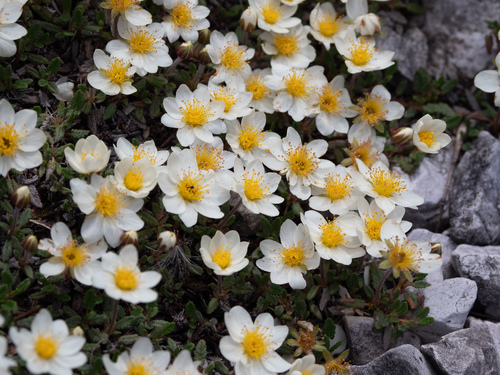
This prostrate plant forms low, dense woody mats typically rising only 3 to 15 centimeters above the ground. Its leaves are small, oblong, and deeply scalloped, resembling tiny oak leaves with dark green, shiny tops and woolly, white felt-like undersides. In early to mid-summer, it produces striking, solitary white flowers, each typically featuring eight petals surrounding a dense dome of bright yellow stamens. When the flowers fade, they transform into spectacular, feathery, twisted seed heads that catch the wind like miniature silver sparklers.
Category
PlantsRarity
Common
Danger
1/5 · Very low
Snaps
Be the first to snap!
Dryas octopetala is the official national flower of Iceland and the territorial flower of the Northwest Territories in Canada.
Its parabolic flowers act like tiny satellite dishes, reflecting sunlight onto the central reproductive organs to keep them up to 8 degrees Celsius warmer than the surrounding air.
The plant is so abundant in fossil records of the last glacial period that two major cold climate epochs, the Older and Younger Dryas, are named after it.
The cup-shaped blossoms act as parabolic reflectors, turning continuously to face the sun and concentrating heat to attract insect pollinators.
It partners with symbiotic Frankia bacteria in its root system, allowing it to thrive in nutrient-poor, rocky, and glacial soils.
Its low-growing, tightly packed woody cushions trap pockets of warm air, protecting the plant from freezing arctic winds.
As a photoautotrophic plant, it produces its own energy through photosynthesis, utilizing sunlight, carbon dioxide, and water, supplemented by soil minerals.
Bombus polaris
Acts as a primary pollinator, attracted to the heat concentrated within the solar-tracking flowers.

Lepus arcticus
Feeds on the evergreen foliage and twigs during winter when other food sources are scarce.
Frankia
Forms root nodules to fix atmospheric nitrogen, providing critical nutrients to the plant in poor soils.
No trait badges are assigned for this object yet.
No aliases listed yet.
Collections for this object will appear here as more themes are added.
Danger
1/5 · Very low
No special safety notes yet.
Start with the whole plant, then compare leaf arrangement, leaf edges, stems and any flowers or fruit. Opposite leaves grow in pairs; alternate leaves come one at a time along the stem. These details tell you far more together than a single green leaf does. Plant Identifier: upload a photo and compare the visible details.
3-15 cm
0.05-0.5 kg
10-100 years
As a photoautotrophic plant, it produces its own energy through photosynthesis, utilizing sunlight, carbon dioxide, and water, supplemented by soil minerals.
Found in rocky arctic tundra, high-altitude alpine meadows, and limestone crevices across the Northern Hemisphere.
Zoom in to split clusters and explore where this object has been snapped.
Recent snaps will appear here as new observations are added.
Take the discovery with you
Snap it with Snappit to identify it, learn what makes it special, and add the discovery to your collection.