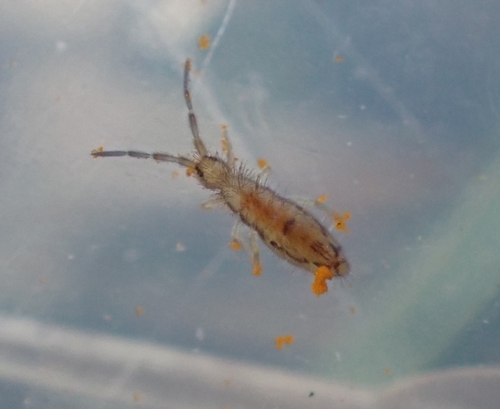


Homidia Socia
homidia socia
Homidia socia is a charming species of elongated springtail belonging to the family Entomobryidae. Widely distributed across temperate regions due to accidental human introduction, these tiny, wingless hexapods play a vital role in soil ecosystems by accelerating the decomposition of organic matter. They are highly active creatures, frequently seen darting through leaf litter or executing impressive leaps when startled. As detritivores, Homidia socia feeds primarily on fungal hyphae, spores, and decaying plant material. By keeping fungal populations in check and breaking down organic debris, they help recycle essential nutrients back into the soil, making them a gardener's hidden best friend. Their resilience and adaptability have allowed them to thrive in both wild woodlands and heavily urbanized gardens.
Habitat: Commonly found in damp, organic-rich environments such as moist leaf litter, rotting logs, compost heaps, and garden mulch.
This minute springtail is extremely small and elongated, characterized by a body covered in fine, dense hairs that give it a slightly fuzzy appearance under magnification. Homidia socia is distinguished by its pale yellowish to light brown base coloration, accented by dark purplish-blue or black bands running transversely across its abdominal segments, particularly prominent on the fourth abdominal segment, which is notably elongated. They possess a specialized, fork-like jumping organ called a furcula tucked beneath their abdomen, which is invisible unless deployed for rapid escape.
Category
AnimalRarity
Common
Danger
1/5 · Very low
Snaps
Be the first to snap!
Springtails like Homidia socia are not true insects; they belong to an ancient lineage of hexapods called Entognatha, which have internal mouthparts.
The genus name Homidia refers to elongated springtails, which are highly valued by terrarium keepers as clean-up crews to control mold and decay.
Their jumping mechanism, the furcula, is held under tension like a mousetrap and can propel them up to 100 times their body length in a fraction of a second.
A specialized tail-like appendage tucked under the abdomen that can be rapidly released, launching the springtail away from danger.
An extremely water-repellent body covering that prevents the tiny organism from drowning and allows it to walk easily on wet surfaces.
A ventral tube structure used to absorb moisture, adhere to slick vertical surfaces, and maintain osmotic balance.
Feeds primarily on microscopic fungi, spores, bacteria, and decaying plant matter within moist soil and litter layers.
Trichoderma harzianum
Feeds extensively on the hyphae and spores of this common soil fungus.
Stratiolaelaps scimitus
Preyed upon by this aggressive, fast-moving predatory mite in soil and compost.
Stenus bimaculatus
Hunted by these specialized beetles that use their sticky tongues to capture springtails.
No trait badges are assigned for this object yet.
No aliases listed yet.
Collections for this object will appear here as more themes are added.
Danger
1/5 · Very low
No special safety notes yet.
Start with body shape, legs or fins, fur, feathers or scales, and standout markings. Then weigh size, habitat and where you saw it. Young animals and seasonal coats can look very different from familiar adults. Animal Identifier: upload a photo and compare the visible details.
up to 1 years
Feeds primarily on microscopic fungi, spores, bacteria, and decaying plant matter within moist soil and litter layers.
Commonly found in damp, organic-rich environments such as moist leaf litter, rotting logs, compost heaps, and garden mulch.
Foraging
10-150
10-25 days
Zoom in to split clusters and explore where this object has been snapped.
Recent snaps will appear here as new observations are added.
Take the discovery with you
Snap it with Snappit to identify it, learn what makes it special, and add the discovery to your collection.