
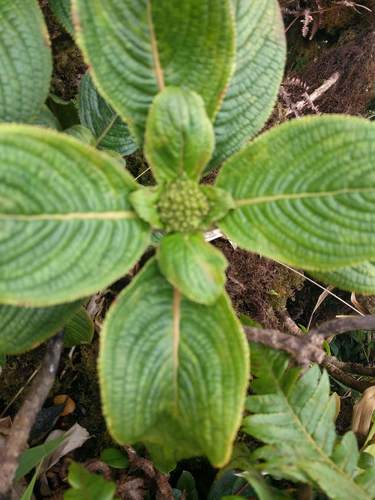


Kanawao
hydrangea arguta
Kanawao (Hydrangea arguta), historically known as Broussaisia arguta, is a beautiful and culturally significant evergreen shrub or small tree endemic to the dense, high-elevation rain forests of the Hawaiian Islands. As a prominent member of the understory vegetation, this resilient species is a classic representative of Hawaii's pristine cloud forests. It plays a vital role in its native ecosystem by stabilizing steep volcanic slopes with its root systems and providing moisture and shelter for endemic fauna.
Habitat: Found in wet Hawaiian rain forests, cloud forests, and along steep, mossy mountain ridges at elevations between 300 and 1,500 meters.
Kanawao typically grows as a sprawling shrub or erect small tree between 1.5 and 6 meters tall. It is characterized by its large, thick, oblong green leaves that have finely serrated margins and prominent veins, arranged oppositely along thick woody stems. The plant produces dome-shaped clusters of small, fleshy flowers at its branch tips that range in color from pale greenish-yellow and delicate pink to rich purplish-blue. Following pollination, these flowers develop into small, attractive, dark reddish-purple berries.
Category
PlantsRarity
Common
Danger
1/5 · Very low
Snaps
Be the first to snap!
Kanawao plants are mostly dioecious, meaning individual plants produce either primarily male or female flowers, which is a common evolutionary strategy in isolated island flora.
The Hawaiian name Kanawao translates roughly to 'of the mountain forest,' referencing its strict preference for high-altitude, misty environments.
While most mainland hydrangeas produce dry seed capsules, Kanawao has evolved fleshy berries, an adaptation to encourage seed dispersal by native forest birds.
Kanawao easily thrives in highly acidic, volcanic soils, possessing cellular mechanisms to withstand high concentrations of soluble aluminum.
It can adjust its growth form, developing as a low, wind-resistant shrub on exposed ridges or as an erect, single-trunked tree under a shaded forest canopy.
Its broad leaves and textured bark efficiently capture moisture from passing clouds and fog, funneling water directly down to its shallow root system.
As an autotrophic plant, Kanawao manufactures its own food through photosynthesis, utilizing chlorophyll to convert sunlight, carbon dioxide, and water into chemical energy.
Theridion grallator
The Hawaiian happy-face spider utilizes the broad, horizontal undersides of Kanawao leaves as shelter to build nests and hunt for prey.
Himatione sanguinea
The native honeycreeper, the 'Apapane, visits the blooming flower clusters of Kanawao to feed on nectar, occasionally aiding in pollination.
Sus scrofa
Invasive feral pigs damage the shallow roots of Kanawao by rooting up the forest floor, spreading invasive weeds that compete with it.
No trait badges are assigned for this object yet.
No aliases listed yet.
Collections for this object will appear here as more themes are added.
Danger
1/5 · Very low
No special safety notes yet.
Start with the whole plant, then compare leaf arrangement, leaf edges, stems and any flowers or fruit. Opposite leaves grow in pairs; alternate leaves come one at a time along the stem. These details tell you far more together than a single green leaf does. Plant Identifier: upload a photo and compare the visible details.
150-600 cm
15-50 years
As an autotrophic plant, Kanawao manufactures its own food through photosynthesis, utilizing chlorophyll to convert sunlight, carbon dioxide, and water into chemical energy.
Found in wet Hawaiian rain forests, cloud forests, and along steep, mossy mountain ridges at elevations between 300 and 1,500 meters.
Photosynthesis
Zoom in to split clusters and explore where this object has been snapped.
Recent snaps will appear here as new observations are added.
Take the discovery with you
Snap it with Snappit to identify it, learn what makes it special, and add the discovery to your collection.


















