

Leather Star
dermasterias imbricata
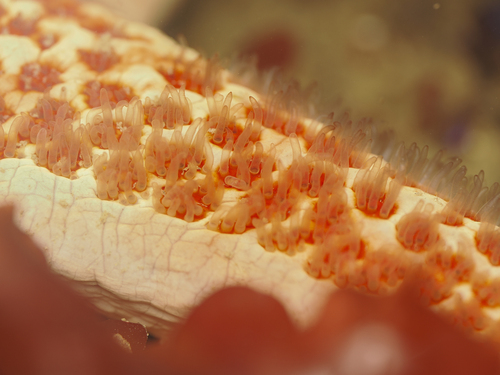
The Leather Star (Dermasterias imbricata) is a fascinating and easily recognizable sea star native to the rocky coasts of the eastern Pacific Ocean. Unlike many of its rough or spiny relatives, this species gets its name from its exceptionally smooth, leathery texture. When handled or exposed to air, the Leather Star is famous for emitting a strong, pungent odor reminiscent of garlic or sulfur. This unique chemical defense mechanism helps deter predators in the highly competitive intertidal and subtidal zones. Typically found clinging to rocky substrates, this unhurried predator plays a crucial role in regulating populations of benthic invertebrates, particularly sea anemones and sea cucumbers. Its presence is a strong indicator of a healthy kelp forest or rocky reef ecosystem. Whether encountered by tide-poolers at low tide or divers exploring deeper kelp beds, the Leather Star stands out as a unique and ecologically vital member of the marine community.
Habitat: Found along rocky coastal shorelines, often inhabiting shallow intertidal zones, tide pools, and kelp forests.
The Leather Star has a broad central disk with five relatively short, triangular arms that taper to blunt tips. Its aboral (top) surface is smooth to the touch, feeling like wet leather due to a thick, fleshy layer of tissue covering its internal skeletal plates. The coloration is characteristically mottled, usually featuring a striking mix of grayish-blue, greenish-brown, or pale blue background adorned with reddish-orange, brown, or purplish irregular patches. The madreporite, or water pore, is visible as a small, distinct, off-center circle on the top of its central disk.
Category
AnimalRarity
Common
Danger
1/5 · Very low
Snaps
1
It doesn't swallow its prey whole; instead, it pushes its stomach out of its mouth to digest food outside of its body.
Sea anemones can sense the chemical trail of an approaching Leather Star and will detach from their rocks to drift away and escape.
Unlike many other starfish that feel rough and spiny, its body is covered in a thick, fleshy skin that feels exactly like wet leather.
When disturbed or taken out of the water, the Leather Star smells strongly of garlic and sulfur.
Secretes a distinct, garlic-like or sulfurous scent when disturbed or removed from the water, which acts as a chemical deterrent against predators.
Like many sea stars, it can expel its stomach out of its mouth to externally digest prey, allowing it to consume organisms larger than its oral opening.
Possesses a uniquely thick, smooth layer of tissue over its internal calcareous plates, protecting it from desiccation and making it difficult for certain predators to grip.
The Leather Star is a slow-moving benthic predator that specializes in feeding on various sessile and slow-moving marine invertebrates.
Age differences: Juveniles consume smaller organisms and biofilms, transitioning to larger invertebrates like anemones as they grow.
Anthopleura elegantissima
Leather Stars frequently prey upon these abundant, intertidal anemones, which sometimes detach and float away in response to the star's chemical trail.
Solaster dawsoni
Morning Sun Stars are aggressive apex predators in the sea star world and will actively hunt and consume Leather Stars.
No trait badges are assigned for this object yet.
No aliases listed yet.
Collections for this object will appear here as more themes are added.
Danger
1/5 · Very low
No special safety notes yet.
Look for fins, arms, tentacles, shells and body symmetry. Underwater light shifts colors, so structure and markings usually matter more than shade. Sea Creature Identifier: upload a photo and compare the visible details.
15-30 cm
0.1-0.5 kg
5-15 years
The Leather Star is a slow-moving benthic predator that specializes in feeding on various sessile and slow-moving marine invertebrates.
Found along rocky coastal shorelines, often inhabiting shallow intertidal zones, tide pools, and kelp forests.
Foraging
Zoom in to split clusters and explore where this object has been snapped.

Alaska, US
You might spot Bald Eagle, Salmonberry, and Ochre Sea Star.
View guide →

US
You might spot Salal, Ochre Sea Star, and Leather Star.
View guide →
British Columbia, CA
You might spot Ochre Sea Star, Fringe Cups, and Moonglow Anemone.
View guide →

British Columbia, CA
You might spot Ochre Sea Star and Yellow Shore Crab.
View guide →

British Columbia, CA
You might spot Salal, Red Huckleberry, and Leather Star.
View guide →
Take the discovery with you
Snap it with Snappit to identify it, learn what makes it special, and add the discovery to your collection.