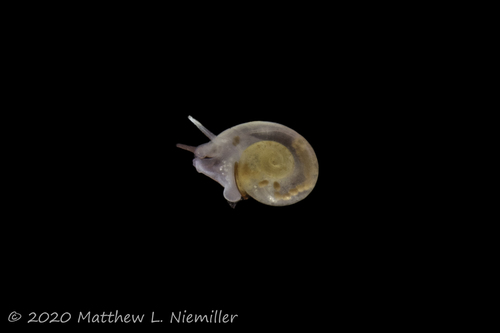


Manitou Cavesnail
antrorbis breweri
The Manitou Cavesnail (Antrorbis breweri) is an incredibly rare, subterranean freshwater snail found exclusively in the dark, pristine waters of Manitou Cave in Alabama, USA. As a stygobiont—an animal completely adapted to life in underground water systems—this tiny mollusk has evolved to thrive in an environment completely devoid of sunlight. It plays a vital role in its highly specialized cave ecosystem by grazing on microscopic biofilms and decaying organic matter that wash into the cave from the surface world.
Habitat: Found exclusively in the cool, slow-moving subterranean freshwater streams and pools within Manitou Cave, Alabama.
The Manitou Cavesnail is a minute gastropod, measuring only about 1.5 to 2.5 millimeters in shell diameter. Its shell is planispiral to low-trochiform, meaning it is mostly flat-coiled, delicate, and translucent-white to colorless, often revealing the pale internal organs. Because it lives in perpetual darkness, it is entirely eyeless and lacks body pigmentation, giving it a ghostly, pale appearance.
Category
InvertebrateRarity
Common
Danger
1/5 · Very low
Snaps
Be the first to snap!
Because they live in absolute darkness, Manitou Cavesnails are completely blind and lack pigment, giving them an otherworldly translucent appearance.
They are so small that several adult Manitou Cavesnails could easily fit on the head of a single match.
This species is a 'single-site endemic,' meaning its entire global population is confined to just one cave system in Alabama.
Having evolved in complete darkness, it has discarded unnecessary eyes to conserve precious metabolic energy.
Lacking sight, it relies on highly sensitive chemical receptors on its tentacles to detect food and navigate its aquatic home.
Adapted to nutrient-poor cave environments, it can survive on minimal food intake by maintaining an extremely slow metabolic rate.
Feeds primarily on organic detritus, bacterial biofilms, and microscopic fungi coating cave stream sediments.
Typhlichthys subterraneus
Predates upon tiny cave invertebrates, including young cavesnails in shallow pool areas.
Cambarus jonesi
Competes for organic detritus and biofilm on submerged cave surfaces.
No trait badges are assigned for this object yet.
No aliases listed yet.
Collections for this object will appear here as more themes are added.
Danger
1/5 · Very low
No special safety notes yet.
Compare body symmetry, shells, segments, legs, tentacles and how the animal moves. Invertebrates span many unrelated groups, so start with body structure. Invertebrate Identifier: upload a photo and compare the visible details.
0 cm
1-3 years
Feeds primarily on organic detritus, bacterial biofilms, and microscopic fungi coating cave stream sediments.
Found exclusively in the cool, slow-moving subterranean freshwater streams and pools within Manitou Cave, Alabama.
Grazing
1-5
14-30 days
Zoom in to split clusters and explore where this object has been snapped.
Recent snaps will appear here as new observations are added.

Alabama, US
You might spot Cave Salamander and Pink Lady's Slipper.
View guide →

Alabama, US
You might spot Cave Salamander and Pink Lady's Slipper.
View guide →
Take the discovery with you
Snap it with Snappit to identify it, learn what makes it special, and add the discovery to your collection.