

Microcystis Smithii
microcystis smithii
Microcystis smithii is a fascinating species of colonial cyanobacteria, commonly referred to as blue-green algae, though it is biologically a bacterium. Thriving in warm, nutrient-rich freshwater environments, this microscopic organism plays a vital role in aquatic ecosystems. On one hand, it is a highly efficient photosynthetic producer, contributing to the global carbon cycle and releasing oxygen into the water. On the other hand, under optimal conditions of high temperature and agricultural runoff, it can multiply rapidly to form dense, conspicuous blooms that dominate the water surface. These colonies are bound together by a protective mucilaginous sheath, allowing them to withstand various environmental stressors. As a key representative of freshwater phytoplankton, Microcystis smithii is of great interest to limnologists and ecologists studying water quality and the impacts of eutrophication worldwide.
Habitat: Found in eutrophic freshwater environments, particularly warm lakes, reservoirs, ponds, and slow-flowing rivers rich in nitrogen and phosphorus.
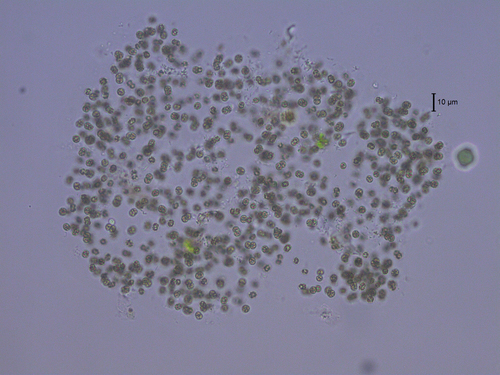
At the microscopic level, Microcystis smithii consists of small, spherical or hemispherical cells measuring roughly 3 to 6 micrometers in diameter. These cells aggregate into larger, highly variable colonies that can appear spherical, oblong, or irregularly lobed, often surrounded by a clear, structured mucilage. To the naked eye, a high concentration of these colonies appears as a vibrant pea-green to blue-green discoloration in the water, resembling spilled paint or a thick, powdery scum floating on the surface.
Category
AnimalRarity
Common
Danger
1/5 · Very low
Snaps
Be the first to snap!
Ancestors of cyanobacteria like Microcystis were responsible for the Great Oxidation Event 2.4 billion years ago, which created Earth's oxygen-rich atmosphere.
Despite being called 'blue-green algae,' Microcystis smithii is actually a photosynthetic bacterium, meaning it lacks a cell nucleus.
Under warm, nutrient-polluted conditions, they can form massive blooms visible from space, turning entire water bodies bright green.
Uses internal gas vesicles to adjust its density, allowing the cells to rise to the water surface for photosynthesis during the day and sink to absorb nutrients at night.
Produces a thick, gelatinous sheath surrounding the colony, which protects the cells from drying out and deters microscopic grazers.
Utilizes sunlight and chlorophyll to split water molecules, generating oxygen as a byproduct, which historically helped shape Earth's atmosphere.
As a photosynthetic cyanobacterium, it generates its own energy from sunlight, carbon dioxide, and inorganic nutrients dissolved in water.
Daphnia magna
Consumes Microcystis cells, though grazing is often limited by colony size and potential toxins.
Hypophthalmichthys molitrix
Filters large quantities of cyanobacteria, helping to control water blooms in managed freshwater ecosystems.
Microcystis virus Ma-LMM01
Infects and lyses Microcystis cells, acting as a natural biological control agent to collapse blooms.
No trait badges are assigned for this object yet.
No aliases listed yet.
Collections for this object will appear here as more themes are added.
Danger
1/5 · Very low
No special safety notes yet.
The easiest way to identify Microcystis Smithii is to use the Snappit nature identifier app.
0 cm
As a photosynthetic cyanobacterium, it generates its own energy from sunlight, carbon dioxide, and inorganic nutrients dissolved in water.
Found in eutrophic freshwater environments, particularly warm lakes, reservoirs, ponds, and slow-flowing rivers rich in nitrogen and phosphorus.
Zoom in to split clusters and explore where this object has been snapped.
Recent snaps will appear here as new observations are added.
Take the discovery with you
Snap it with Snappit to identify it, learn what makes it special, and add the discovery to your collection.