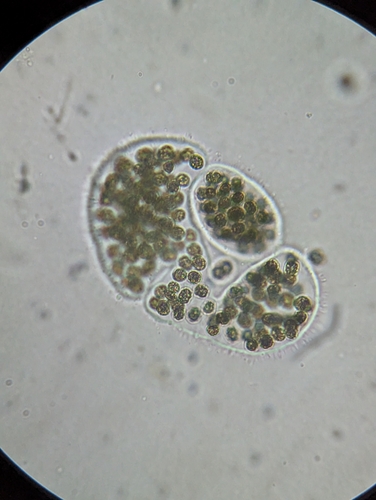


Microcystis Wesenbergii
microcystis wesenbergii
Microcystis wesenbergii is a fascinating, colonial single-celled cyanobacterium commonly found in freshwater environments globally. Known for forming floating colonies, this photosynthetic bacterium plays a complex role in aquatic ecosystems. While it contributes to primary productivity by harvesting sunlight, it is also famous for its involvement in harmful algal blooms under nutrient-rich conditions. Unlike some of its notorious relatives, Microcystis wesenbergii is often considered less toxic or non-toxic, though it frequently co-occurs with toxin-producing species. Encased in a distinct, well-defined gelatinous sheath, these microscopic organisms cluster together, using buoyancy-regulating gas vesicles to move up and down the water column to optimize light absorption.
Habitat: Found floating in eutrophic freshwater lakes, reservoirs, ponds, and slow-moving rivers worldwide.
Microcystis wesenbergii forms spherical, lobed, or irregularly shaped colonies that range from pale green to blue-green in color. Individual cells are spherical, measuring about 4 to 7 micrometers in diameter, and are packed within a highly visible, refractile, and structured mucilaginous envelope. This outer gelatinous sheath has a sharp, distinct boundary that clearly distinguishes it from other Microcystis species under a light microscope. Macroscopically, dense accumulations look like green pea-soup or spilled paint on the water surface.
Category
AnimalRarity
Common
Danger
1/5 · Very low
Snaps
Be the first to snap!
They use specialized gas vesicles to climb up to the surface during the day to photosynthesize, and sink at night to absorb nutrients from cooler, deeper waters.
Under a microscope, the defining feature of Microcystis wesenbergii is its remarkably crisp, glass-like outer gelatinous border, which looks like a clear halo.
While some Microcystis species produce deadly microcystin toxins, M. wesenbergii is generally considered non-toxic, though it often lives alongside highly toxic cousins.
Uses gas-filled vesicles within its cells to adjust its vertical position in the water column, rising to harvest sunlight or sinking to access deeper nutrients.
Produces a thick, resilient outer mucilage envelope that protects cells from mechanical damage, desiccation, and chemical fluctuations in the environment.
Utilizes phycobiliproteins alongside chlorophyll to capture light wavelengths that other photosynthetic organisms cannot use, allowing it to thrive in turbid waters.
As a photosynthetic cyanobacterium, it generates its own energy from sunlight, water, and carbon dioxide, while absorbing dissolved nutrients like phosphorus and nitrogen directly from the surrounding water.
Daphnia magna
Zooplankton like Daphnia graze on cyanobacteria, though they may struggle to digest larger colonies.
Hypophthalmichthys molitrix
Silver carp filter-feed on phytoplankton, including Microcystis colonies, helping control blooms in lakes.
No trait badges are assigned for this object yet.
No aliases listed yet.
Collections for this object will appear here as more themes are added.
Danger
1/5 · Very low
No special safety notes yet.
The easiest way to identify Microcystis Wesenbergii is to use the Snappit nature identifier app.
As a photosynthetic cyanobacterium, it generates its own energy from sunlight, water, and carbon dioxide, while absorbing dissolved nutrients like phosphorus and nitrogen directly from the surrounding water.
Found floating in eutrophic freshwater lakes, reservoirs, ponds, and slow-moving rivers worldwide.
Zoom in to split clusters and explore where this object has been snapped.
Recent snaps will appear here as new observations are added.
Take the discovery with you
Snap it with Snappit to identify it, learn what makes it special, and add the discovery to your collection.