
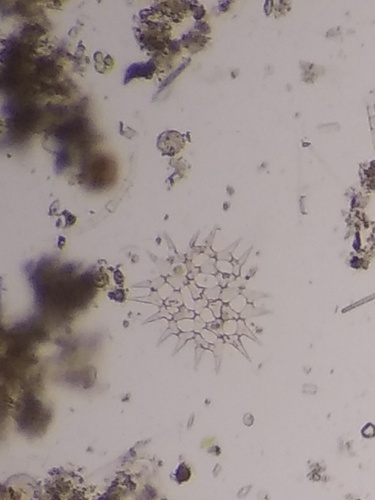


Monactinus Biwae
monactinus biwae
Monactinus Biwae is a beautiful, microscopic green alga renowned for its striking star-like geometric symmetry. Operating as a free-floating colonial organism, it consists of a single-layered disc of cells precisely arranged in concentric rings. This microalga plays a vital role in freshwater food webs, serving as a primary producer that converts solar energy into organic matter while oxygenating its aquatic environment.
Habitat: Inhabits the open waters of freshwater lakes, reservoirs, and slow-moving rivers, thriving as a component of floating phytoplankton.
Under a microscope, Monactinus Biwae resembles a green, wheel-like structure or gear. It forms flat, disc-shaped colonies (coenobia) typically consisting of 8, 16, 32, or 64 cells. The inner cells are polygonal and fit tightly together, while each outer cell is characterized by a single, prominent, outward-pointing horn or spine, giving the entire colony a starburst appearance. The cells are rich in green chlorophyll, which gives them a vibrant, grass-green coloration.
Category
PlantsRarity
Common
Danger
1/5 · Very low
Snaps
Be the first to snap!
It is named after Lake Biwa in Japan, the country's largest freshwater lake, where it was historically studied in detail.
Its outer cells feature a single horn-like projection, which distinguishes the genus Monactinus from its close relative Pediastrum, which typically has two.
The number of cells in a colony is determined at birth and does not increase; individual cells simply grow larger as the colony matures.
The flat, single-layered disc structure maximizes surface area exposure to sunlight, optimizing the efficiency of its photosynthetic process.
During reproduction, motile zoospores gather inside a temporary vesicle and spontaneously align into a perfect geometric colony before developing cell walls.
The cell wall contains robust, decay-resistant biopolymers that protect the colony from sudden osmotic shifts and physical damage.
As a photosynthetic organism, it manufactures its own food using sunlight, carbon dioxide, and dissolved inorganic nutrients from the water.
Daphnia pulex
Serves as a vital source of nutrition for filter-feeding zooplankton.
Microcystis aeruginosa
Competes for dissolved phosphorus and nitrogen in freshwater lakes.
No trait badges are assigned for this object yet.
No aliases listed yet.
Collections for this object will appear here as more themes are added.
Danger
1/5 · Very low
No special safety notes yet.
Start with the whole plant, then compare leaf arrangement, leaf edges, stems and any flowers or fruit. Opposite leaves grow in pairs; alternate leaves come one at a time along the stem. These details tell you far more together than a single green leaf does. Plant Identifier: upload a photo and compare the visible details.
0 cm
As a photosynthetic organism, it manufactures its own food using sunlight, carbon dioxide, and dissolved inorganic nutrients from the water.
Inhabits the open waters of freshwater lakes, reservoirs, and slow-moving rivers, thriving as a component of floating phytoplankton.
Photosynthesis
8-64
Zoom in to split clusters and explore where this object has been snapped.
Recent snaps will appear here as new observations are added.
Take the discovery with you
Snap it with Snappit to identify it, learn what makes it special, and add the discovery to your collection.

















