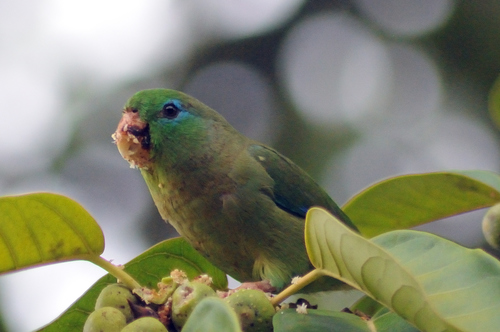


New World And African Parrots
psittacidae
The family Psittacidae, comprising the New World and African parrots, showcases some of the most vibrant, intelligent, and charismatic birds on Earth. From the massive, brilliantly colored macaws of the Amazon basin to the small, energetic lovebirds of the African savannah, these birds are renowned for their highly social behavior and remarkable cognitive abilities. Many species possess the incredible ability to mimic human speech and solve complex puzzles, reflecting their large brain-to-body ratio. In their native ecosystems, they play essential roles as seed predators and occasional dispersers, helping to shape forest structure.
Habitat: Found primarily in tropical and subtropical regions, these parrots typically inhabit dense rainforests, woodlands, savannas, and sometimes montane forests or semi-arid scrublands.
Birds in this family are highly recognizable by their strongly curved, powerful bills, upright stance, and zygodactyl feet, which have two toes pointing forward and two pointing backward. Their plumage is extraordinarily diverse and vibrant, often dominated by brilliant greens, deep blues, radiant yellows, and rich reds. Sizes range dramatically across the family, with the smallest parrotlets measuring around 10 centimeters and the largest macaws extending up to 100 centimeters in length. They typically feature broad, rounded wings and can have either short, square tails or long, elegant tail feathers.
Category
BirdsRarity
Common
Danger
1/5 · Very low
Snaps
Be the first to snap!
Parrots are among the few bird groups that regularly use their feet to hold food and bring it to their mouths while eating.
Some parrot species visit clay licks along riverbanks to consume mineral-rich clay, which helps neutralize toxins found in the wild seeds they eat.
They are known to be left- or right-footed, showing a distinct preference for using one foot over the other when manipulating objects.
They form extremely strong, lifelong monogamous pair bonds, often flying and feeding close together even within large flocks.
With two toes facing forward and two facing backward, they possess an incredibly strong grip that allows them to climb trees vertically and manipulate food with single-footed precision.
Many species have highly developed syrinxes and complex brains, enabling them to mimic a vast array of environmental sounds, including human speech, to communicate within their flocks.
Their heavily curved, hinged upper mandibles can apply immense pressure, allowing them to crack open tough-shelled nuts and seeds that other animals cannot access.
Primarily feed on a variety of seeds, nuts, fruits, nectar, and buds, often utilizing their powerful bills to break open hard shells.
Age differences: Chicks are fed regurgitated, partially digested food from their parents until they fledge and learn to forage for hard seeds and fruits on their own.

Harpia harpyja
The Harpy Eagle is a major apex predator that actively hunts medium to large New World parrots, such as macaws, in the canopy.
Bertholletia excelsa
Large macaws use their powerful beaks to break open the extremely hard woody pods of the Brazil nut tree to feed on the seeds.
No trait badges are assigned for this object yet.
Collections for this object will appear here as more themes are added.
Danger
1/5 · Very low
No special safety notes yet.
Compare the silhouette, bill shape, tail length, wing bars and markings around the eyes. The same small brown bird at your feeder can look quite different in breeding plumage, winter plumage or its first year. Bird Identifier: upload a photo and compare the visible details.
10-100 cm
15-115 cm
0.01-1.7 kg
15-80 years
65 km/h
Primarily feed on a variety of seeds, nuts, fruits, nectar, and buds, often utilizing their powerful bills to break open hard shells.
Found primarily in tropical and subtropical regions, these parrots typically inhabit dense rainforests, woodlands, savannas, and sometimes montane forests or semi-arid scrublands.
Zoom in to split clusters and explore where this object has been snapped.
Recent snaps will appear here as new observations are added.

Texas, US
You might spot Giraffes, African Lion, and Eastern Black Rhinoceros.
View guide →

New Jersey, US
You might spot African Lion, Snow Leopard, and Reticulated Giraffe.
View guide →

Massachusetts, US
You might spot American Bison, Domestic Bactrian Camel, and Black Bear.
View guide →

Indiana, US
You might spot Panthera Pardus Orientalis and Reticulated Giraffe.
View guide →

California, US
You might spot African Elephant, Reticulated Giraffe, and African Lion.
View guide →
Nevada, US
You might spot African Lion, Tiger, and Zebra.
View guide →
Take the discovery with you
Snap it with Snappit to identify it, learn what makes it special, and add the discovery to your collection.