
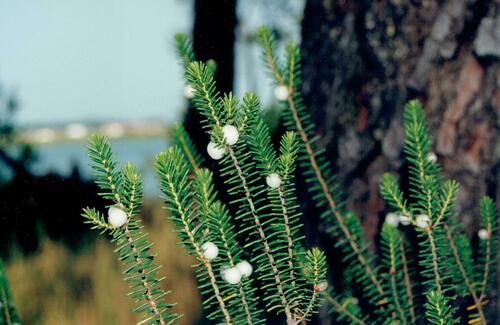


Portuguese Crowberry
corema album
The Portuguese Crowberry (Corema album), known locally as camarinha, is a fascinating evergreen shrub endemic to the Atlantic dunes of the Iberian Peninsula. This hardy coastal survivor thrives in harsh, nutrient-poor sands where few other plants can persist. Historically, its pearl-like white berries were a popular wild treat, harvested by coastal communities for their refreshing, slightly acidic flavor. Today, this plant is recognized as a vital ecological cornerstone of dune ecosystems, helping stabilize shifting sands and providing essential sustenance to local wildlife. Despite its resilience, coastal development and habitat fragmentation pose ongoing challenges to its survival, making it a key species of conservation concern in Portugal and Spain.
Habitat: Found in coastal sand dunes and maritime pine forests along the Atlantic coast of the Iberian Peninsula and southwest France.
A low-growing, densely branched shrub, the Portuguese Crowberry typically reaches 30 to 100 centimeters in height. It features small, needle-like, dark green leaves that release a pleasant rosemary-like fragrance when crushed. The plant is dioecious, meaning individual shrubs are either male or female; during late winter, male plants display inconspicuous, reddish-brown flowers, while female plants produce the species' most distinct feature: glossy, translucent white or light pink berries that resemble tiny pearls, clustering abundantly along the branches during late summer.
Category
PlantsRarity
Common
Danger
1/5 · Very low
Snaps
Be the first to snap!
In the 19th century, the acidic, refreshing berries were regularly sold by street vendors in Portuguese coastal towns as a thirst-quenching snack.
The berries of the Portuguese Crowberry are unique among European crowberries for being white, earning them the nickname 'pearls of the dunes'.
The genus name 'Corema' comes from the Greek word for 'broom', referring to the shrub's historical use in making traditional sweeping brooms.
Deep, extensive root systems bind loose sand, stabilizing fragile coastal dunes against strong wind erosion.
Tiny, needle-like ericoid leaves minimize surface area, drastically reducing water loss through transpiration in dry, sandy soils.
Releases specialized chemical compounds into the surrounding soil to inhibit the growth of competing plant species.
As a photoautotrophic plant, it synthesizes its own sugars through photosynthesis, utilizing solar energy, water, and carbon dioxide.

Vulpes vulpes
Consumes the sweet white berries and disperses the seeds across the sand dunes through its droppings.
Cyanopica cooki
Feeds on the ripe berries during late summer, serving as an effective seed dispersal agent.

Carpobrotus edulis
An aggressive invasive plant that competes directly with the crowberry for space, water, and nutrients on coastal dunes.
No trait badges are assigned for this object yet.
No aliases listed yet.
Collections for this object will appear here as more themes are added.
Danger
1/5 · Very low
No special safety notes yet.
Compare how the fruit is clustered, the leaves and their arrangement, the stems and any thorns. Red, blue and black fruits grow on lots of unrelated plants, and the same color can show up on both edible and poisonous species. Berry Identifier: upload a photo and compare the visible details.
30+ cm
1+ kg
15+ years
As a photoautotrophic plant, it synthesizes its own sugars through photosynthesis, utilizing solar energy, water, and carbon dioxide.
Found in coastal sand dunes and maritime pine forests along the Atlantic coast of the Iberian Peninsula and southwest France.
60+ days
Zoom in to split clusters and explore where this object has been snapped.
Recent snaps will appear here as new observations are added.
Take the discovery with you
Snap it with Snappit to identify it, learn what makes it special, and add the discovery to your collection.


















