

Portuguese Man O' War
physalia physalis
Often mistaken for a jellyfish, the Portuguese Man O' War is actually a highly specialized colonial organism known as a siphonophore. Rather than being a single animal, it is composed of four distinct types of individuals, or zooids, that work in perfect harmony to survive. Floating on the surface of warm open oceans, it relies entirely on winds and ocean currents to navigate, serving as a striking example of cooperative biological complexity. Its otherworldly appearance and powerful, venomous tentacles make it one of the most infamous and captivating spectacles of the marine world. Each colony is genetically identical, but the individual components specialize in tasks like reproduction, feeding, defense, and keeping the colony afloat.
Habitat: Found floating on the surface of warm, open tropical and subtropical oceans, completely at the mercy of winds and currents.
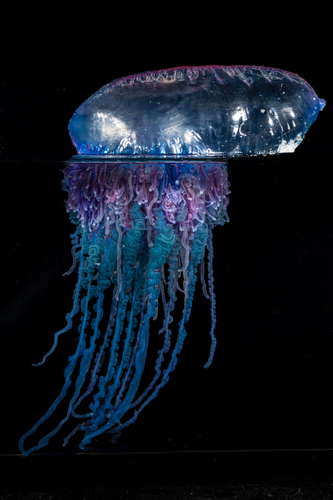
This creature is easily identified by its translucent, gas-filled bladder (the pneumatophore), which floats on the water's surface and flashes vibrant shades of blue, purple, and pink. This sail-like float can measure up to 30 centimeters in length and rises about 15 centimeters above the water. Beneath this float trail incredibly long, dark blue or purple tentacles that can average 10 meters in length, and sometimes extend up to 30 meters, covered in stinging cells.
Category
AnimalRarity
Common
Danger
1/5 · Very low
Snaps
Be the first to snap!
It is named after an 18th-century Portuguese armed sailing ship because its gas-filled float resembles a sail at full mast.
It is not a single animal, but a colonial organism made of four types of specialized individuals (zooids) that cannot survive on their own.
Its float is filled with up to 14% carbon monoxide, which is produced biochemically by the organism itself.
The gas-filled bladder acts as a sail, catching ocean breezes to propel the colony across vast oceanic distances.
The organism consists of four highly specialized zooids that perform separate tasks like defense, feeding, floating, and reproduction.
Its tentacles contain thousands of nematocysts that inject a potent neurotoxin to quickly paralyze prey and ward off predators.
It captures and paralyzes small fish, larvae, and plankton using its long, venom-filled tentacles.

Caretta caretta
It is a primary food source for this sea turtle species, which is immune to the stinging venom.
Nomeus gronovii
This species of fish lives symbiotically among the tentacles, avoiding stingers and feeding on leftover scraps.
Tremoctopus violaceus
This cephalopod immune to the toxin rips the stinging tentacles of the Man O' War to use them as a defensive tool.
No trait badges are assigned for this object yet.
No aliases listed yet.
Collections for this object will appear here as more themes are added.
Danger
1/5 · Very low
No special safety notes yet.
Look for fins, arms, tentacles, shells and body symmetry. Underwater light shifts colors, so structure and markings usually matter more than shade. Sea Creature Identifier: upload a photo and compare the visible details.
9-30 cm
0.1-0.5 kg
1 years
It captures and paralyzes small fish, larvae, and plankton using its long, venom-filled tentacles.
Found floating on the surface of warm, open tropical and subtropical oceans, completely at the mercy of winds and currents.
Ambush
Zoom in to split clusters and explore where this object has been snapped.
Recent snaps will appear here as new observations are added.

Florida, US
You might spot Brown Anole, Laughing Gull, and Green Iguana.
View guide →

Florida, US
You might spot Brown Anole and Northern Curly-Tailed Lizard.
View guide →

Florida, US
You might spot Laughing Gull, Brown Anole, and Green Iguana.
View guide →

US
You might spot Brown Anole and Green Iguana.
View guide →

Florida, US
You might spot Brown Anole and Northern Curly-Tailed Lizard.
View guide →
Take the discovery with you
Snap it with Snappit to identify it, learn what makes it special, and add the discovery to your collection.