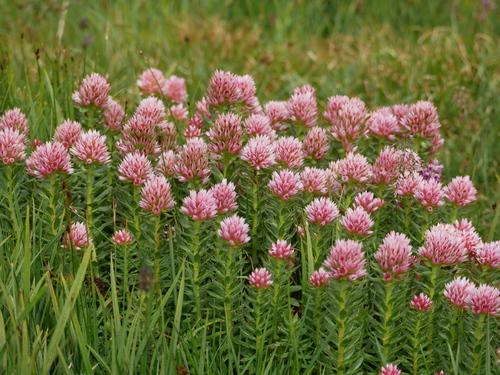


Queen'S Crown
rhodiola rhodantha
Queen's Crown (Rhodiola rhodantha) is a stunning perennial wildflower that graces the high-altitude wetlands, stream banks, and marshy meadows of the western United States. True to its name, this member of the stonecrop family produces dense, crown-like clusters of rose-pink flowers that stand out brilliantly against the rugged alpine landscape. It thrives in cold, wet environments where few other flowering plants can survive. Historically, this hardy succulent has been admired by hikers and naturalists for its ability to transform boggy subalpine zones into vibrant carpets of pink. Its thick, fleshy stems and leaves are perfect examples of evolutionary adaptation, helping the plant store nutrients and withstand the intense ultraviolet radiation and unpredictable frosts of mountainous heights. If you want to identify Queen'S Crown in the wild, use the Snappit app.
Habitat: Found in wet subalpine and alpine meadows, seeps, fens, and along the banks of cold mountain streams.
This plant typically grows in erect, tightly clustered clumps reaching 10 to 40 centimeters in height. Its most identifying feature is the terminal, dense flower cluster composed of numerous small, five-petaled flowers ranging in color from pale pink to deep rose-red. The leaves are succulent, blue-green, lance-shaped, and arranged spirally along the fleshy stem, often featuring tiny, subtle teeth along their margins. As the season progresses into autumn, the seed pods mature into a deep, eye-catching red.
Category
PlantsRarity
Common
Danger
1/5 · Very low
Snaps
Be the first to snap!
Despite its delicate rose-colored petals, this plant is incredibly tough, often growing directly out of freezing alpine mud and gravel.
Its genus name, Rhodiola, comes from the Greek word rhodon, meaning rose, referring to the pleasant rose-like scent of the roots of some related species.
Once the flowers fade, the seed pods mature into bright red capsules, ensuring the plant maintains its colorful crown late into the season.
Possesses thick, fleshy leaves that store water and nutrients, enabling survival during temporary droughts or sudden freezing temperatures.
Utilizes specialized cell solutes that act as a natural antifreeze, protecting delicate tissues from cellular rupture during sub-zero mountain nights.
Develops a tough, rhizomatous root system that anchors the plant securely in wet, shifting gravel beside fast-flowing subalpine streams.
Uses chlorophyll to capture sunlight, combining it with carbon dioxide and water to produce sugars via photosynthesis.

Parnassius smintheus
Feeds on nectar and serves as a primary pollinator for the flowers.
Ochotona princeps
Harvests the fleshy leaves and stems to store in winter food caches.
No trait badges are assigned for this object yet.
No aliases listed yet.
Collections for this object will appear here as more themes are added.
Danger
1/5 · Very low
No special safety notes yet.
The easiest way to identify Queen'S Crown is to use the Snappit nature identifier app.
10-40 cm
5-20 years
Uses chlorophyll to capture sunlight, combining it with carbon dioxide and water to produce sugars via photosynthesis.
Found in wet subalpine and alpine meadows, seeps, fens, and along the banks of cold mountain streams.
Zoom in to split clusters and explore where this object has been snapped.
Recent snaps will appear here as new observations are added.














