

Scarabaeus Cicatricosus
scarabaeus cicatricosus
Scarabaeus cicatricosus is a remarkable species of dung beetle native to the western Mediterranean, particularly the southern Iberian Peninsula and parts of North Africa. As a quintessential ecosystem engineer, this industrious insect plays an indispensable role in nutrient cycling, soil aeration, and seed dispersal. By sculpting and rolling massive spheres of mammalian dung, it secures both a rich food source for itself and a nursery for its future offspring. Watching this beetle navigate rough terrain while pushing a ball several times its own weight is a testament to its extraordinary strength and biological determination. Sadly, changes in traditional pastoral farming and the widespread use of livestock pharmaceuticals pose significant challenges to its survival, making this species a vital focus for regional conservation efforts.
Habitat: Found in dry Mediterranean grasslands, pastures, and open shrublands where herbivorous livestock graze.
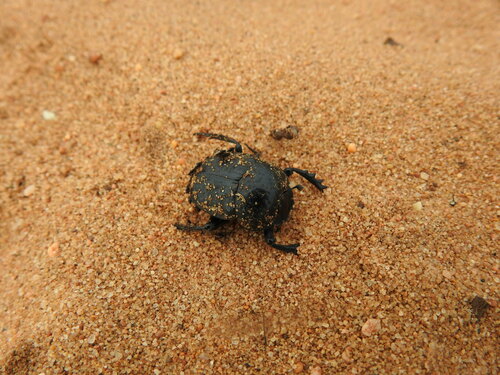
This medium-sized beetle typically ranges from 2.0 to 3.0 centimeters in length and is characterized by a robust, oval body with a deep, matte-black coloration. Its most defining feature is the textured, heavily punctured surface of its elytra, which resembles a series of scars or cicatrices—giving the species its scientific name. It possesses broad, spade-like forelegs heavily modified for digging and sculpting dung, while its fan-like antennae are highly sensitive to chemical cues in the air.
Category
InsectsRarity
Common
Danger
1/5 · Very low
Snaps
Be the first to snap!
Like other Scarabaeus species, they roll dung balls backward using their hind legs while walking upside down with their heads facing the ground.
The species name 'cicatricosus' refers to the scar-like craters on its wing covers, which help distinguish it from other smooth-bodied scarabs.
They are highly sensitive to the chemical components of fresh dung, capable of flying directly toward a new dung source within minutes of its deposition.
This beetle uses the polarized light of the sun, moon, and even the Milky Way to maintain a straight course while rolling dung balls away from competitors.
Equipped with specialized, serrated forelegs and a shovel-like clypeus, it can rapidly burrow into compacted soil to bury its dung ball safely.
It is capable of rolling and transporting dung spheres that weigh up to several dozen times its own body mass over uneven terrain.
Feeds almost exclusively on the dung of herbivorous and omnivorous mammals, favoring fresh cattle, sheep, and horse droppings.
Age differences: Larvae feed inside the buried brood ball on the dung provided by their parents, while adults actively forage for fresh dung on the surface.
Ovis aries
Provides the beetle with its primary food source and material for brood balls.

Vulpes vulpes
Preys upon dung beetles as they forage on the surface.
Sisyphus schaefferi
Competes for fresh dung resources to build brood balls.
No trait badges are assigned for this object yet.
No aliases listed yet.
Collections for this object will appear here as more themes are added.
Danger
1/5 · Very low
No special safety notes yet.
Look for hard wing covers meeting in a line down the back, then compare the antennae, body shape, legs and markings. Metallic colors shift a lot with lighting. Beetle Identifier: upload a photo and compare the visible details.
2+ cm
4+ cm
0.001+ kg
1+ years
5 km/h
Feeds almost exclusively on the dung of herbivorous and omnivorous mammals, favoring fresh cattle, sheep, and horse droppings.
Found in dry Mediterranean grasslands, pastures, and open shrublands where herbivorous livestock graze.
Zoom in to split clusters and explore where this object has been snapped.
Recent snaps will appear here as new observations are added.
Take the discovery with you
Snap it with Snappit to identify it, learn what makes it special, and add the discovery to your collection.