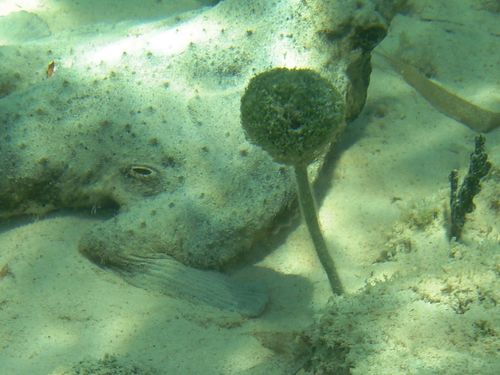


Shaving Brush Alga
penicillus capitatus
The Shaving Brush Alga is a captivating marine green alga that looks remarkably like an old-fashioned barber's shaving brush. Found anchored in the warm, shallow waters of the tropical Western Atlantic, this unique alga plays a vital role in its ecosystem. Unlike many other seaweeds that cling to rocks, it prefers soft substrates like sand or mud, anchoring itself with a bulbous root-like structure. Beyond its quirky appearance, it is a major ecological contributor, producing oxygen through photosynthesis and generating fine white sand when its calcified body breaks down after death.
Habitat: Thrives in shallow, sheltered marine environments like lagoon flats, seagrass beds, and sandy or muddy seabeds of tropical and subtropical waters.
This distinctive alga grows up to 15 centimeters in height and is characterized by a stiff, calcified, light green to whitish stalk (stipe) topped by a dense, brush-like tuft of fine, bright green filaments. The 'brush' consists of numerous slender, dichotomously branched filaments that capture sunlight. Its calcified nature gives the stalk a rigid, somewhat chalky texture, while the green crown remains relatively soft but structurally intact underwater.
Category
PlantsRarity
Common
Danger
1/5 · Very low
Snaps
Be the first to snap!
Despite its complex, multi-branched shape, the entire shaving brush alga is structurally a single, giant, multi-nucleated cell.
Its stiff, calcium carbonate-rich structure acts as a natural defense system, making it highly unpalatable to most herbivorous reef fish.
When the alga dies, its calcified skeleton breaks down into fine white mud, contributing significantly to the famous white-sand beaches of the Caribbean.
Deposits calcium carbonate within its cell walls, giving it a rigid structure that deters herbivores and contributes to carbonate sand production upon its death.
Utilizes a dense, bulbous network of rhizoids to anchor itself securely in loose, shifting sand or mud where other macroalgae struggle to attach.
Consists of a single giant coenocytic cell with multiple nuclei, allowing rapid transport of nutrients and organelles throughout its entire body without cell wall barriers.
As a photosynthetic organism, it generates its own energy from sunlight, carbon dioxide, and dissolved marine nutrients.
Elysia crispata
The lettuce sea slug feeds on the shaving brush alga, sucking out its cytoplasm and retaining the chloroplasts to photosynthesize for itself.
Thalassia testudinum
Shares shallow sandy habitats and competes for space, light, and benthic nutrients in lagoon ecosystems.
No trait badges are assigned for this object yet.
No aliases listed yet.
Collections for this object will appear here as more themes are added.
Danger
1/5 · Very low
No special safety notes yet.
Start with the whole plant, then compare leaf arrangement, leaf edges, stems and any flowers or fruit. Opposite leaves grow in pairs; alternate leaves come one at a time along the stem. These details tell you far more together than a single green leaf does. Plant Identifier: upload a photo and compare the visible details.
5-15 cm
0.01-0.05 kg
As a photosynthetic organism, it generates its own energy from sunlight, carbon dioxide, and dissolved marine nutrients.
Thrives in shallow, sheltered marine environments like lagoon flats, seagrass beds, and sandy or muddy seabeds of tropical and subtropical waters.
Photosynthesis
Zoom in to split clusters and explore where this object has been snapped.
Recent snaps will appear here as new observations are added.
Take the discovery with you
Snap it with Snappit to identify it, learn what makes it special, and add the discovery to your collection.