
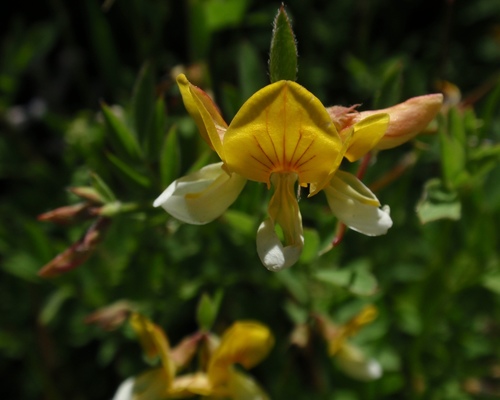


Streambank Bird'S-Foot Trefoil
hosackia oblongifolia
Streambank Bird's-Foot Trefoil (Hosackia oblongifolia) is a charming perennial herb native to western North America, recognized for its vibrant yellow flowers and its preference for moist, riparian habitats. This member of the pea family (Fabaceae) plays a crucial ecological role by enriching the soil through nitrogen fixation, a process carried out by symbiotic bacteria in its root nodules. Its presence often indicates a healthy wetland or streamside ecosystem, providing both visual beauty and essential ecological services, supporting local biodiversity through its nectar production.
Habitat: Found along streambanks, in moist meadows, open slopes, seeps, and under the dappled shade of wet coniferous forests, thriving in consistently damp soil conditions.
This herbaceous perennial typically grows 20-60 cm tall, forming erect to sprawling stems. Its foliage consists of pinnately compound leaves, each with multiple oblong to elliptic leaflets arranged alternately along the stem. The most striking feature is its inflorescence: clusters of bright yellow, pea-like flowers, often tinged with reddish-brown veins, arranged in umbrella-shaped umbels atop slender stalks. The flowers eventually give way to slender, elongated seed pods that mature to a dark color.
Category
PlantsRarity
Common
Danger
1/5 · Very low
Snaps
Be the first to snap!
As a member of the legume family (Fabaceae), it significantly enriches soil health by hosting nitrogen-fixing bacteria in its root nodules, converting atmospheric nitrogen into a usable form for itself and neighboring plants.
Its common name, 'Bird's-Foot Trefoil,' refers to the arrangement of its slender seed pods, which can resemble a bird's foot with outstretched toes.
The genus 'Hosackia' is named after David Hosack, a prominent American botanist and physician who was instrumental in establishing botanical gardens and medical education in the early 19th century.
While some related Bird's-Foot Trefoil species are cultivated for forage or cover crops, Hosackia oblongifolia primarily exists as a wild species, playing an important role in natural riparian ecosystems.
Symbiotic bacteria (Rhizobia) in its root nodules convert atmospheric nitrogen into a usable form, enriching the surrounding soil for itself and other plants in the ecosystem.
Equipped with root systems and physiological traits that allow it to tolerate and thrive in saturated soils typical of its streambank and wet meadow habitats, making it resilient to fluctuating water levels.
Its bright yellow, nectar-rich, pea-like flowers are specifically adapted in shape and color to attract a variety of insect pollinators, such as bees and butterflies, ensuring effective reproduction.
As an autotrophic plant, Streambank Bird's-Foot Trefoil produces its own food through photosynthesis, utilizing sunlight, carbon dioxide from the air, and water and mineral nutrients absorbed from the soil.
Bombus spp.
Pollinates flowers while collecting nectar, aiding in the plant's reproduction.
Rhizobium spp.
Forms a symbiotic relationship in root nodules to fix atmospheric nitrogen, providing essential nutrients.
Odocoileus hemionus columbianus
Grazes on foliage and tender shoots, impacting plant growth but typically not causing severe harm.
Papilio rutulus
Adult butterflies feed on the nectar from the flowers, contributing to pollination.
No trait badges are assigned for this object yet.
No aliases listed yet.
Collections for this object will appear here as more themes are added.
Danger
1/5 · Very low
No special safety notes yet.
Start with the whole plant, then compare leaf arrangement, leaf edges, stems and any flowers or fruit. Opposite leaves grow in pairs; alternate leaves come one at a time along the stem. These details tell you far more together than a single green leaf does. Plant Identifier: upload a photo and compare the visible details.
20-60 cm
0.01-0.05 kg
2-10 years
As an autotrophic plant, Streambank Bird's-Foot Trefoil produces its own food through photosynthesis, utilizing sunlight, carbon dioxide from the air, and water and mineral nutrients absorbed from the soil.
Found along streambanks, in moist meadows, open slopes, seeps, and under the dappled shade of wet coniferous forests, thriving in consistently damp soil conditions.
Photosynthesis
10-50
Zoom in to split clusters and explore where this object has been snapped.
Recent snaps will appear here as new observations are added.
Take the discovery with you
Snap it with Snappit to identify it, learn what makes it special, and add the discovery to your collection.


















