

Striped Dogwinkle
nucella ostrina
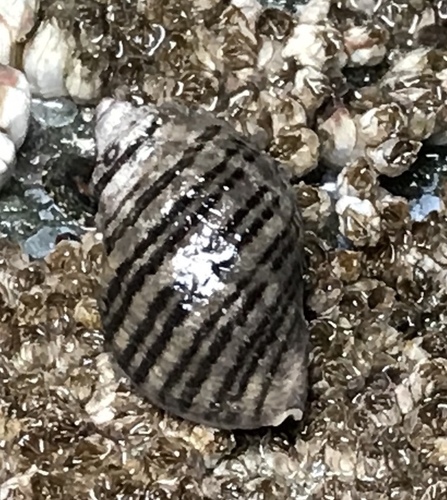
The Striped Dogwinkle (Nucella ostrina) is a small but formidable predatory sea snail found along the rugged rocky coastlines of the eastern Pacific Ocean. Despite its modest size and colorful, often striped shell, it is a fierce hunter of the intertidal zone, preying on heavily armored creatures like barnacles and mussels. Equipped with a specialized, drill-like tongue called a radula, the dogwinkle painstakingly bores through the protective shells of its victims. Highly adaptable, this species varies wildly in appearance and even alters its physical shell characteristics in response to the presence of local predators and wave action. This remarkable phenotypic plasticity makes the Striped Dogwinkle a fascinating subject of evolutionary biology and marine ecology, showcasing how dynamic and responsive intertidal life must be to survive.
Habitat: Found exclusively in the rocky intertidal zones of coastal shorelines, often clinging tightly to rocks among dense beds of mussels and barnacles.
This marine snail features a thick, robust shell that typically reaches 1 to 4 centimeters in length. The shell's surface is heavily textured with pronounced spiral ridges and is highly variable in color, commonly displaying striking bands or stripes of white, brown, black, grey, or dull orange. The opening, or aperture, is oval and frequently lined with small, tooth-like ridges on the outer lip. Depending on wave exposure, individuals in calmer waters may have more prominent, elevated ridges, while those in high-surf areas tend to have smoother, wider, and thicker shells to withstand the crashing water.
Category
InvertebrateRarity
Common
Danger
1/5 · Very low
Snaps
Be the first to snap!
Instead of releasing free-swimming larvae into the ocean, the Striped Dogwinkle lays distinct, vase-shaped yellow egg capsules known as 'sea oats', from which fully formed, tiny snails hatch directly onto the rocks.
It can take a Striped Dogwinkle up to two full days of continuous scraping and chemical secretion just to drill a single hole through the shell of a mussel.
The color of a dogwinkle's shell is heavily influenced by its diet; snails that feed predominantly on dark mussels tend to be darker in color, while those eating barnacles generally have much lighter shells.
When a dogwinkle drills into a prey's shell, it leaves behind a perfectly round, tiny countersunk hole that looks as though it was made by a microscopic power drill.
Uses a specialized, file-like ribbon of teeth called a radula to physically bore perfectly round, beveled holes through the hard shells of its prey.
Secretes a weak acid from a specialized gland in its foot that softens the calcium carbonate shell of its prey, aiding the mechanical drilling process.
Can dynamically alter its shell growth to be thicker and more robust when it senses chemical cues from predatory crabs in the surrounding water.
A strict predator of the intertidal zone, primarily hunting sessile or slow-moving invertebrates with hard shells.
Age differences: Juveniles target smaller, thinner-shelled barnacles, while adult dogwinkles transition to tackling larger barnacles and thicker mussels.
Balanus glandula
A primary prey species heavily targeted by the dogwinkle.
Mytilus californianus
Preyed upon by adult Striped Dogwinkles along exposed shorelines.
Pisaster ochraceus
A common intertidal predator that feeds on dogwinkles.
Cancer productus
Predatory crab whose chemical presence causes the dogwinkle to grow a thicker shell.
No trait badges are assigned for this object yet.
No aliases listed yet.
Collections for this object will appear here as more themes are added.
Danger
1/5 · Very low
No special safety notes yet.
Compare the overall shape, opening, spiral, ribs, hinge and surface sculpture. Beach shells often lose the colors and sharp edges they had on the living animal, so shape does most of the work. Seashell Identifier: upload a photo and compare the visible details.
1-4 cm
0.005-0.03 kg
5-15 years
A strict predator of the intertidal zone, primarily hunting sessile or slow-moving invertebrates with hard shells.
Found exclusively in the rocky intertidal zones of coastal shorelines, often clinging tightly to rocks among dense beds of mussels and barnacles.
Foraging
100-500
Zoom in to split clusters and explore where this object has been snapped.
Recent snaps will appear here as new observations are added.
Take the discovery with you
Snap it with Snappit to identify it, learn what makes it special, and add the discovery to your collection.