

Tracy'S Sundew
drosera tracyi
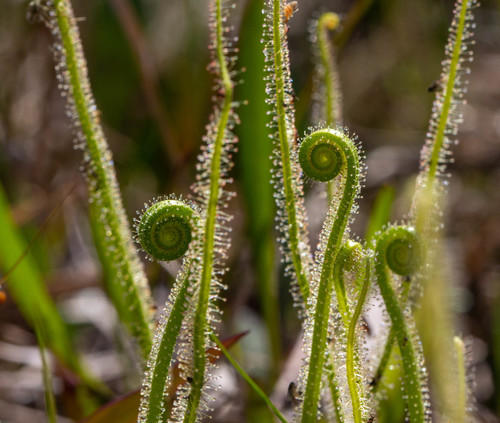
Tracy's Sundew (Drosera tracyi) is a fascinating carnivorous plant native to the southeastern United States. It stands out among its sundew relatives for its unusually long, erect, grass-like leaves, which are adorned with glistening, sticky tentacles. These tentacles serve as a natural flypaper, luring and trapping small insects that land on them. Adapted to survive in nutrient-poor, acidic wetland environments, the sundew supplements its nutritional needs by digesting its insect prey. This remarkable adaptation allows it to thrive where most other plants would struggle, making it a unique and vital component of its specialized ecosystem.
Habitat: Tracy's Sundew is typically found in acidic, nutrient-poor, sandy soils of wet pine savannas, bogs, and seepage slopes.
Tracy's Sundew is characterized by its linear, erect leaves that can grow up to 30 centimeters long, giving it a distinct grass-like appearance. These leaves are covered in numerous reddish glandular hairs, or tentacles, each tipped with a droplet of clear, sticky mucilage that shimmers in the sunlight. The plant forms a basal rosette, often appearing as a clump of these elongated, dewy leaves. Its flowers, typically white or pinkish, are borne on a tall scape, rising above the sticky foliage to avoid trapping potential pollinators.
Category
PlantsRarity
Common
Danger
1/5 · Very low
Snaps
Be the first to snap!
Its long, linear leaves can reach up to 30 cm (12 inches) in length, making it one of the largest sundew species native to North America.
The glistening 'dew' on its leaves is actually a highly viscous mucilage that serves as an effective insect trap, rather than actual water droplets.
Tracy's Sundew is named after Samuel M. Tracy, a prominent American botanist who extensively studied flora of the Gulf Coast states.
Unlike some sundews that form compact rosettes, Drosera tracyi often grows erect, with leaves resembling blades of grass, allowing it to blend into its savanna habitat.
Glandular hairs on its leaves produce a glistening, highly viscous mucilage that acts as a natural flypaper, effectively trapping unsuspecting insects.
Once prey is caught, the plant secretes a cocktail of digestive enzymes to break down the soft tissues of the insect, absorbing essential nitrogen and phosphorus.
The tentacles, and sometimes the entire leaf, can slowly bend inwards over several minutes or hours to maximize contact with and digestion of captured prey.
Tracy's Sundew is a carnivorous plant that supplements its nutrient intake by trapping and digesting small insects. This adaptation allows it to thrive in nutrient-poor, acidic soils where essential nutrients are scarce.

Aphidoidea
Provides habitat and is sometimes consumed by sap-sucking insects, though many are trapped.
Sarracenia flava
Shares the same nutrient-poor wetland habitat, often growing in close proximity.

Halictidae
Pollinates the flowers, enabling reproduction, typically avoiding the sticky leaves.

Formicidae
A common prey item caught and digested by the plant's sticky leaves.
No trait badges are assigned for this object yet.
Collections for this object will appear here as more themes are added.
Danger
1/5 · Very low
No special safety notes yet.
Start with the whole plant, then compare leaf arrangement, leaf edges, stems and any flowers or fruit. Opposite leaves grow in pairs; alternate leaves come one at a time along the stem. These details tell you far more together than a single green leaf does. Plant Identifier: upload a photo and compare the visible details.
10-30 cm
0.001-0.005 kg
1-3 years
Tracy's Sundew is a carnivorous plant that supplements its nutrient intake by trapping and digesting small insects. This adaptation allows it to thrive in nutrient-poor, acidic soils where essential nutrients are scarce.
Tracy's Sundew is typically found in acidic, nutrient-poor, sandy soils of wet pine savannas, bogs, and seepage slopes.
Passive Trapping
Zoom in to split clusters and explore where this object has been snapped.
Recent snaps will appear here as new observations are added.
Take the discovery with you
Snap it with Snappit to identify it, learn what makes it special, and add the discovery to your collection.