
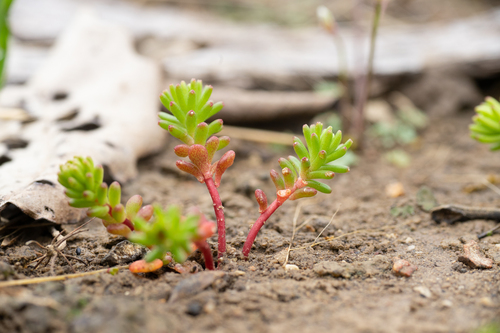


Widow'S-Cross
sedum pulchellum
Widow'S-Cross (Sedum pulchellum) is an enchanting annual stonecrop native to the limestone glades and rocky outcrops of the southeastern United States. Named for the unique, cross-like horizontal alignment of its flowering branches, this plant blooms in late spring, creating stunning carpets of pale pink to white star-shaped flowers. It thrives in shallow, rocky soils where few other plants can survive, capitalizing on wet spring conditions before dry summer heat sets in. As a succulent, it has evolved smart water-retention mechanisms to endure dry spells, making it a rugged and resilient pioneer species that paints arid limestone barrens with vibrant, delicate color. Native plant enthusiasts cherish it for its striking geometric symmetry and ecological toughness.
Habitat: Found in damp, shallow soils over limestone outcrops, cedar glades, and rocky bluff ledges.
This low-growing annual succulent typically reaches heights of 10 to 30 cm. It is easily distinguished by its fleshy, light green, cylindrical leaves that are densely packed along the stems. In late spring, the plant produces four to five spreading, horizontal branches arranged in a flat, cross-like shape. Each branch is lined with numerous small, five-petaled, star-shaped flowers that transition from pale pink to white, occasionally showing deeper pink highlights at the center.
Category
PlantsRarity
Common
Danger
1/5 · Very low
Snaps
Be the first to snap!
It is a classic pioneer species of cedar glades, an ecosystem known for extreme conditions that mimic deserts in summer and wetlands in winter.
The common name 'Widow's-Cross' comes from the distinctive cross-shaped arrangement of its flowering spike branches.
Unlike many other Sedum species which are perennial, Sedum pulchellum is an obligate annual, completing its entire life cycle in a single year.
Utilizes Crassulacean Acid Metabolism to fix carbon dioxide at night, minimizing water loss through transpiration during dry daytime hours.
Seeds are designed to be washed away by rainwater across rock surfaces to find new soil pockets for autumn germination.
The succulent leaves store reserves of water, allowing the plant to survive prolonged dry spells in shallow soil.
As a photoautotrophic plant, it produces its own energy via photosynthesis, utilizing sunlight, carbon dioxide, and water while absorbing minerals from the soil.
Apis mellifera
Bees visit the showy flowers for nectar and pollen, acting as primary pollinators.
Minuartia patula
Shares the thin limestone glade soils and competes for shallow moisture in spring.
Trichoplusia ni
The caterpillars of this moth occasionally feed on the fleshy succulent leaves of Sedum species.
No trait badges are assigned for this object yet.
No aliases listed yet.
Collections for this object will appear here as more themes are added.
Danger
1/5 · Very low
No special safety notes yet.
Compare leaf arrangement, rosette shape, ribs, spines and flowers. Keep in mind that drought and strong sun can shift a plant's color and shape. Succulent Identifier: upload a photo and compare the visible details.
10-30 cm
1 years
As a photoautotrophic plant, it produces its own energy via photosynthesis, utilizing sunlight, carbon dioxide, and water while absorbing minerals from the soil.
Found in damp, shallow soils over limestone outcrops, cedar glades, and rocky bluff ledges.
Zoom in to split clusters and explore where this object has been snapped.
Recent snaps will appear here as new observations are added.
Take the discovery with you
Snap it with Snappit to identify it, learn what makes it special, and add the discovery to your collection.


















