




Gaur
Bos gaurus
The Gaur is a big, strong animal that looks like a giant cow. They are gentle giants and love to munch on grass and leaves in forests.
Habitat: Forests and grasslands in Asia
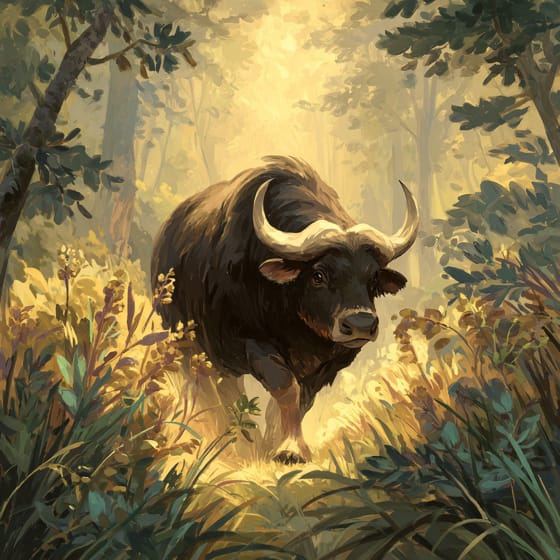
The Gaur is the largest wild cattle, sporting a massive, muscular dark brown to black body with distinct white 'stockings' on its lower legs. It has a large head, broad forehead, and powerful curved horns that sweep backward, making it instantly recognizable.
Category
MammalsRarity
Common
Danger
2/5 · Low
Snaps
Be the first to snap!
A gaur's shoulders can be taller than an adult human!
Baby gaurs, called calves, stay close to their mothers for protection!
They communicate with growls and snorts that can sound like a cow!
They love to eat tough bamboo, even the woody parts!
Gaur can use their excellent hearing and acute sense of smell to detect predators from a distance, keeping them safe.
Gaur has strong, curved horns that can grow over 100cm long, which helps them defend against predators.
A huge plant-eater, Gaur munch on grasses, leaves, and bamboo to get all their energy.
Panthera tigris
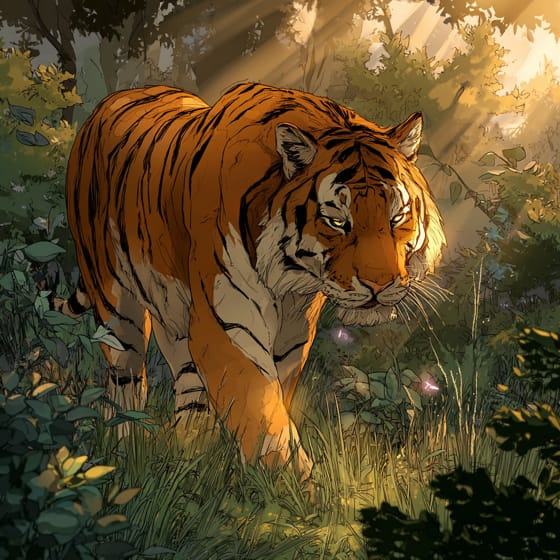
Preys on Gaur, especially calves and weaker adults.
Cuon alpinus
Packs of dholes can hunt Gaur, often targeting young ones.
Bambusa tulda
A primary food source, providing essential nutrients.
Furry describes animals possessing a dense covering of soft hair or fur.
Crested describes animals possessing a prominent tuft of feathers, hair, or skin on their head.
Social animals live in organized groups, cooperating for survival benefits such as foraging, defense, and raising offspring.
Characterized by having one or more hard, permanent, pointed projections on the head.

This trait characterizes organisms whose diet consists entirely or primarily of plant material.

Forest habitats are terrestrial environments dominated by dense tree cover, supporting a high diversity of plant and animal life.

Describes a species whose presence and role have a disproportionately large effect on its environment.

Giant describes organisms or objects of significantly larger size than average for their species or type.
Danger
2/5 · Low
Gaur are usually friendly, but it's best to admire them from a distance and not to approach them.
250-330 cm
650-1500 kg
25-30 years
50 km/h
A huge plant-eater, Gaur munch on grasses, leaves, and bamboo to get all their energy.
Forests and grasslands in Asia
Grazing
1
Zoom in to split clusters and explore where this object has been snapped.
Recent snaps will appear here as new observations are added.