Blanding's Turtle
Emydoidea blandingii
Blanding's Turtle has a smooth, shiny shell that looks like it’s wearing a helmet! They are friendly turtles that like to swim.
Habitat: Wetlands and ponds
The Blanding's Turtle has a distinct bright yellow throat and chin, contrasting with its dark, domed shell that is often speckled with lighter flecks. Its lower shell is yellowish with dark blotches, and it features a unique hinged plastron.
Category
ReptilesRarity
Rare
Danger
2/5 · Low
Snaps
Be the first to snap!
Blanding's Turtles can gobble up food underwater without drinking a single drop!
If startled, these turtles can snap their hinged shell shut like a secret door!
The temperature of the nest decides if a baby Blanding's Turtle will be a boy or a girl!
They bury themselves in mud at the bottom of ponds to survive freezing winters.
Blanding's Turtle can eat its prey underwater without swallowing water, thanks to its unique mouth structure, helping them hunt efficiently.
Blanding's Turtle has a hinged lower shell that helps them enclose their head and limbs almost completely, protecting them from danger.
Blanding's Turtle can travel long distances over land, using its powerful legs to move between different wetland habitats for food or nesting.
A carnivore that uses its powerful jaws to crunch on crayfish, insects, and small fish.
Age differences: Young turtles consume more aquatic plants, but adults are primarily meat-eaters.

Procyon lotor
Raccoons often raid turtle nests, eating eggs and hatchlings.
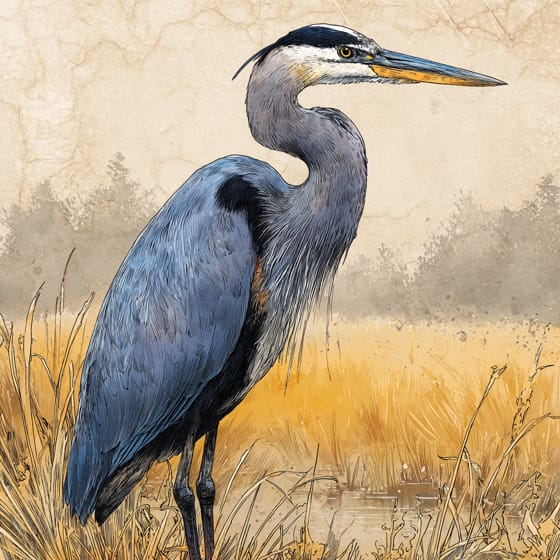
Ardea herodias
Large wading birds can prey on small or young Blanding's Turtles.
Cambarus bartonii
Turtles actively hunt and eat various native crayfish species.
Typha latifolia
Dense cattail stands provide excellent cover and hiding spots.
Wildlife encompasses all undomesticated animal and plant life existing in their natural habitats.
This trait identifies organisms whose diet includes both plant and animal matter.
This trait signifies organisms belonging to a very old evolutionary group with ancestors dating back millions of years.
This trait characterizes organisms with an exceptionally long lifespan compared to others of their kind.

This habitat trait identifies species found in wetlands, which are areas of land saturated with water, either permanently or seasonally, including marshes, swamps, and bogs.

Armored describes animals protected by a hard, external covering or shell for defense.

Nocturnal animals are primarily active during the nighttime hours, typically resting or sleeping during the day.
Danger
2/5 · Low
Look but don’t touch. Keep a safe distance and wash hands after exploring.
18-26 cm
1-2.5 kg
50-75 years
0.5 km/h
A carnivore that uses its powerful jaws to crunch on crayfish, insects, and small fish.
2 km/h
Wetlands and ponds
Ambush and Foraging
Zoom in to split clusters and explore where this object has been snapped.
Recent snaps will appear here as new observations are added.