Common Map Turtle
Graptemys geographica
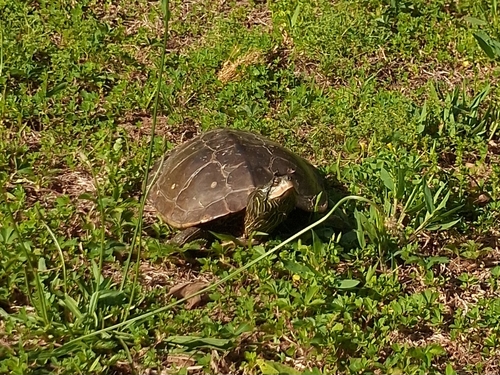
The Common Map Turtle has a beautiful, patterned shell that looks like a map. They enjoy basking on rocks and are great at swimming!
Habitat: Rivers and lakes
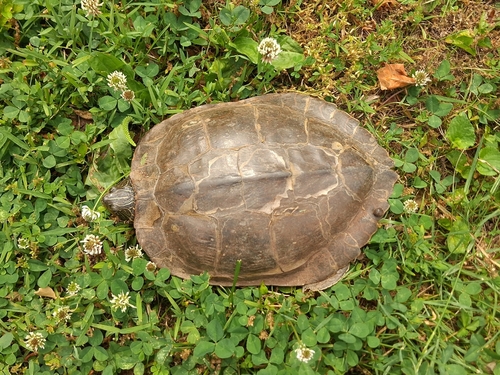
The Common Map Turtle has an olive-green shell covered in fine yellow lines, resembling a topographic map. Its head and limbs feature similar yellow streaks, with a small yellow spot behind each eye. A prominent keel runs down the center of its shell.
Category
ReptilesRarity
Common
Danger
2/5 · Low
Snaps
22
Each turtle's shell pattern is unique, like a human fingerprint, making them special.
Female map turtles grow much bigger than males, almost twice their size!
The temperature of the nest decides if a baby map turtle will be a boy or a girl!
These turtles love to bask together in sunny spots, sometimes stacked on top of each other!
Common Map Turtle can spot tiny prey from a distance because of their excellent underwater vision.
Common Map Turtle has intricate map-like patterns on its shell that help them blend into rocky riverbeds.
These turtles are mostly carnivores, munching on snails, insects, and small fish in their watery homes.
Age differences: Younger turtles eat more insects, while adults mainly feast on snails, clams, and crayfish.

Procyon lotor
Eggs and hatchlings are vulnerable to predation.
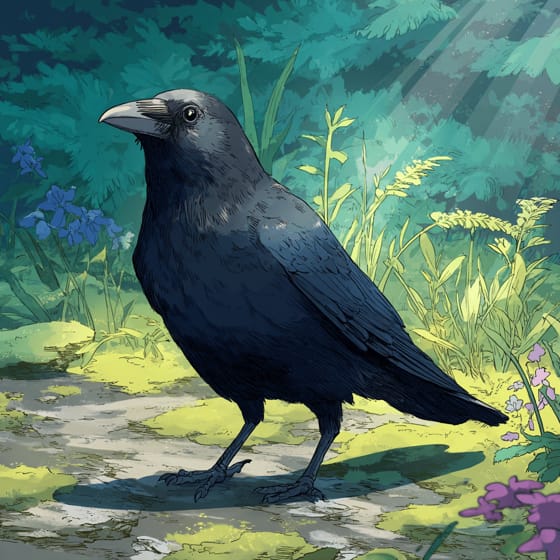
Corvus brachyrhynchos
Crows often raid nests for turtle eggs.
Physa acuta
Predominantly feeds on various freshwater snails.
Orconectes rusticus
Adult turtles crush and consume these crustaceans.
Wildlife encompasses all undomesticated animal and plant life existing in their natural habitats.
Piscivorous organisms are animals that primarily subsist on a diet of fish.
This trait characterizes organisms with an exceptionally long lifespan compared to others of their kind.
Armored describes animals protected by a hard, external covering or shell for defense.

Diurnal animals are primarily active during daylight hours, typically resting or sleeping at night.

Freshwater habitats include non-saline aquatic environments such as rivers, lakes, ponds, and wetlands, vital for numerous species.
Danger
2/5 · Low
Look but don’t touch. Keep a safe distance and wash hands after exploring.
The easiest way to identify Common Map Turtle is to use the Snappit nature identifier app.
10-30 cm
0.1-2.5 kg
15-30 years
0.5 km/h
These turtles are mostly carnivores, munching on snails, insects, and small fish in their watery homes.
4 km/h
Rivers and lakes
Zoom in to split clusters and explore where this object has been snapped.
Jun 7, 2026
PrallsvillePhoto attribution
(c) Susan Mott, some rights reserved (CC BY-SA)
License: CC BY-SA 4.0 ↗
Image may be shown cropped inside the card frame.
Jun 7, 2026
PrallsvillePhoto attribution
(c) Susan Mott, some rights reserved (CC BY-SA)
License: CC BY-SA 4.0 ↗
Image may be shown cropped inside the card frame.
Jun 6, 2026
PrallsvillePhoto attribution
(c) Susan Mott, some rights reserved (CC BY-SA)
License: CC BY-SA 4.0 ↗
Image may be shown cropped inside the card frame.

Illinois, US
You might spot Brown-Belted Bumble Bee and Eastern Gray Squirrel.
View guide →

Michigan, US
You might spot Monarch, Canada Goose, and Eastern Gray Squirrel.
View guide →

Michigan, US
You might spot Monarch, Canada Goose, and Eastern Gray Squirrel.
View guide →

Michigan, US
You might spot Monarch, Canada Goose, and Eastern Gray Squirrel.
View guide →

Michigan, US
You might spot Monarch, Canada Goose, and Eastern Gray Squirrel.
View guide →

Michigan, US
You might spot Monarch, Canada Goose, and Eastern Gray Squirrel.
View guide →
Take the discovery with you
Snap it with Snappit to identify it, learn what makes it special, and add the discovery to your collection.