



Arthrophaga Myriapodina
arthrophaga myriapodina
Arthrophaga myriapodina is a remarkable and somewhat macabre species of entomopathogenic fungus. Belonging to a specialized group of fungi that parasitize arthropods, this species is uniquely adapted to target millipedes. Once its spores penetrate the host's exoskeleton, the fungus begins a quiet invasion, growing inside the living millipede and consuming its non-vital tissues. As it prepares to reproduce, the fungus dramatically alters the host's behavior, hijacking its nervous system to induce "summit disease." This forces the dying millipede to climb to an elevated, exposed position before its demise. This fascinating, manipulative ecological interaction makes Arthrophaga myriapodina a striking example of a parasitic life cycle, transforming its host into a spore-dispersing vehicle to ensure the next generation's survival.
Habitat: Found in moist, temperate deciduous forests, particularly in areas with rich leaf litter and decaying wood where host millipedes are abundant.
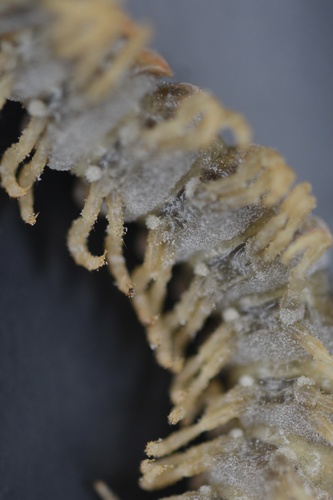
This fungus is rarely encountered on its own and is almost exclusively identified by its presence on a deceased host millipede. When actively reproducing, Arthrophaga myriapodina manifests as fuzzy, whitish to pale-yellow tufts of fungal growth (conidiophores) that vividly erupt from the intersegmental membranes—the softer bands between the millipede's hardened, armor-like plates. The infected host is typically found clinging unnaturally tight to a twig, leaf, or rock at a high elevation, rigidified by the extensive fungal network within its body.
Category
FungiRarity
Common
Danger
1/5 · Very low
Snaps
Be the first to snap!
Infected millipedes often lock their legs in a 'death grip' around the plant they climbed before dying, keeping their bodies securely anchored during the spore-dispersal process.
It belongs to a specialized group of fungi that have independently evolved 'zombie-making' traits, similar to the famous Ophiocordyceps fungi that infect ants.
The genus name Arthrophaga translates directly to 'joint eater,' perfectly describing how the fungus emerges from the joints of the millipede's exoskeleton.
The spores are actively shot from the fruiting bodies, acting like microscopic fungal cannons to ensure they land on new hosts foraging below.
The fungus alters the neural chemistry of the infected millipede, compelling it to climb to a high, exposed location before dying.
By positioning the dead host high above the ground, the fungus maximizes the dispersal area when forcefully ejecting its spores onto the leaf litter below.
The fungus specifically emerges through the softer membranes between the host's hardened exoskeleton plates to form its spore-producing structures.
The fungus derives all of its nutrients by digesting the internal tissues and hemolymph of living and recently deceased millipedes.
Age differences: Starts as an endoparasite consuming non-vital tissues, then switches to consuming vital organs immediately prior to host death.
Apheloria virginiensis
The primary host species that the fungus manipulates and ultimately kills.
Euryurus leachii
Another woodland millipede species occasionally targeted and consumed by the fungus.
Solitary animals live alone for most of their lives, only interacting with others for mating or parental care.
Burrowing animals dig tunnels and chambers in the ground, using these subterranean structures for shelter, hunting, or breeding.
Describes organisms that break down dead organic material, recycling nutrients back into the ecosystem.
Forest habitats are terrestrial environments dominated by dense tree cover, supporting a high diversity of plant and animal life.
Nocturnal animals are primarily active during the nighttime hours, typically resting or sleeping during the day.
Collections for this object will appear here as more themes are added.
Danger
1/5 · Very low
No special safety notes yet.
Compare the cap shape, the underside, the stem and base, and whether the fungus grows on wood or soil. Some fungi have gills, others pores or teeth. A cap seen only from above often hides the most useful features. Mushroom Identifier: upload a photo and compare the visible details.
2-5 cm
The fungus derives all of its nutrients by digesting the internal tissues and hemolymph of living and recently deceased millipedes.
Found in moist, temperate deciduous forests, particularly in areas with rich leaf litter and decaying wood where host millipedes are abundant.
Passive Contact
7-14 days
Zoom in to split clusters and explore where this object has been snapped.
Recent snaps will appear here as new observations are added.
Take the discovery with you
Snap it with Snappit to identify it, learn what makes it special, and add the discovery to your collection.