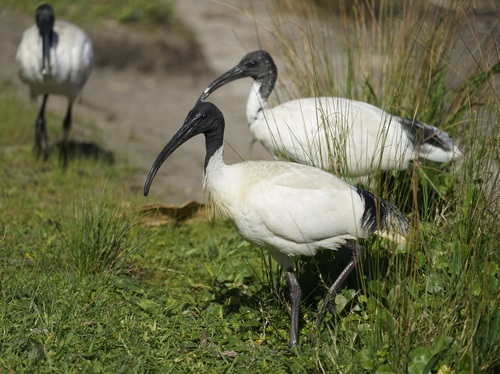


Australian Ibis
threskiornis molucca
The Australian Ibis, commonly referred to as the Australian White Ibis, is one of Australia's most recognizable and highly adaptable bird species. Originally a resident of inland wetlands and marshes, this resourceful avian has successfully transitioned to coastal urban environments. Often seen in public parks, city plazas, and landfill sites, it has earned a unique place in contemporary Australian culture, affectionately known as the 'bin chicken.' Despite their somewhat notorious urban reputation, they play a crucial ecological role in controlling pest insect populations and cleaning up organic waste in natural wetlands. In the wild, these birds are highly social, nesting in large colonies called rookeries, often alongside other wading birds. Their bold, inquisitive nature and willingness to interact closely with humans make them a fascinating subject of study in urban ecology.
Habitat: Typically found in wetlands, swamps, lagoons, and increasingly in urban parks, gardens, and landfills.
This large wading bird is easily identified by its predominantly white plumage, which is accented by a bald, featherless black head and neck. It features a highly distinctive, long, black bill that curves dramatically downward, ideal for probing deep mud or trash. In flight, their wings reveal black tips and a striking patch of bare red skin on the underside near the breast. Their legs are long and dark, allowing them to wade comfortably through shallow water and urban debris.
Category
BirdsRarity
Common
Danger
1/5 · Very low
Snaps
Be the first to snap!
Colloquially known as the 'bin chicken' in Australia due to its notorious habit of rummaging through public trash cans.
Despite their modern urban reputation, they are closely related to the African Sacred Ibis, which was revered in ancient Egypt.
Historically, their presence in coastal cities was triggered by inland droughts, driving them away from dried-up wetlands.
They are intelligent enough to use specific techniques to open secured garbage bins and tear open plastic bags to access food.
Uses a highly sensitive, long bill packed with nerve endings to detect movement and prey buried deep in soft mud or water.
Exhibits highly flexible cognitive skills allowing it to navigate human landscapes, open trash bins, and exploit artificial food sources.
Utilizes unfeathered red skin patches under its wings to dissipate excess body heat and communicate with potential mates.
Highly opportunistic feeders that consume a mix of aquatic invertebrates, small vertebrates, and scavenged human food scraps.
Age differences: Chicks are fed regurgitated food by parents, transitioning to independent foraging as juveniles.
Varanus varius
Predates on eggs and chicks in nesting colonies.
Cherax destructor
Serves as a major native food source in natural freshwater wetland habitats.

Vulpes vulpes
An introduced predator that preys on nesting adults and fledglings on the ground.
No trait badges are assigned for this object yet.
No aliases listed yet.
Collections for this object will appear here as more themes are added.
Danger
1/5 · Very low
No special safety notes yet.
Compare the silhouette, bill shape, tail length, wing bars and markings around the eyes. The same small brown bird at your feeder can look quite different in breeding plumage, winter plumage or its first year. Bird Identifier: upload a photo and compare the visible details.
65-75 cm
110-125 cm
1.4-2.5 kg
10-15 years
50 km/h
Highly opportunistic feeders that consume a mix of aquatic invertebrates, small vertebrates, and scavenged human food scraps.
Typically found in wetlands, swamps, lagoons, and increasingly in urban parks, gardens, and landfills.
Zoom in to split clusters and explore where this object has been snapped.
Recent snaps will appear here as new observations are added.
Take the discovery with you
Snap it with Snappit to identify it, learn what makes it special, and add the discovery to your collection.