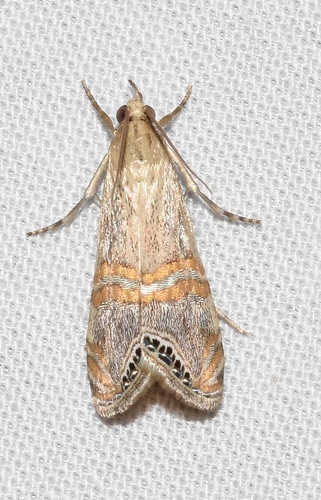


Belted Grass-Veneer
euchromius ocellea
The Belted Grass-Veneer (Euchromius ocellea) is a small but beautifully marked moth belonging to the Crambidae family, commonly known as grass moths. True to its name, this fascinating insect features intricate metallic bands and striking eye-like spots, or ocelli, on the edges of its wings. It is an incredibly widespread species, thriving in diverse warm habitats across the globe, from the Mediterranean to parts of Africa, Asia, and the Americas. Because of its fondness for dry, sandy environments, it has successfully adapted to a variety of semi-arid and agricultural landscapes. While the adult moths flit delicately among vegetation or gather around artificial lights at night, the larvae lead a more hidden life. They construct protective silken tubes at the base of various grasses, where they quietly feed on roots and dry plant material. Its wide distribution and intricate wing patterns make the Belted Grass-Veneer a delightful find for macro photographers and moth enthusiasts.
Habitat: Found primarily in dry grasslands, savannas, sandy areas, and agricultural fields where its host grasses are abundant.
This small moth has a wingspan ranging from 1.6 to 2.7 centimeters. Its forewings are predominantly pale golden-yellow to sandy brown, finely dusted with darker scales. The defining visual characteristics are the distinct metallic transverse bands (the "belts") and a row of black, metallic-centered terminal eye spots (ocelli) along the outer margin of the forewings. At rest, it folds its wings tightly along its body, giving it a narrow, cylindrical profile that allows it to blend perfectly into dry grass stems.
Category
InsectsRarity
Common
Danger
1/5 · Very low
Snaps
Be the first to snap!
Because of its tightly wrapped resting posture, it belongs to a group of Crambidae often nicknamed 'snout moths' or 'grass-veneers' due to their wood-grain-like camouflage.
Despite its fragile appearance, the Belted Grass-Veneer is incredibly adaptable and has managed to colonize almost every continent except Antarctica.
The metallic spots on its wings are made of microscopic scales that reflect light, creating a shimmering effect that can confuse visually hunting predators.
Larvae construct specialized silken tubes near the roots of grasses, protecting them from predators and extreme weather while they feed.
The striking eye spots (ocelli) on the outer margins of the forewings draw the attention of predators away from the moth's vulnerable head and body.
By rolling its wings tightly around its slender body when resting, the moth perfectly mimics a piece of dry grass or a broken stem.
Larvae primarily feed on the roots, stems, and dried leaves of various grasses, while adults may occasionally sip nectar.
Age differences: Larvae are entirely herbivorous feeding on tough grass tissues, whereas short-lived adults consume only liquid nectar if they feed at all.
Braconidae
Parasitoid wasps often target the larvae inside their protective silken tubes.
Pipistrellus pipistrellus
Insectivorous bats prey on the adult moths during their nocturnal flights.

Cynodon dactylon
Larvae utilize dry grasses as their primary food source and habitat.
No trait badges are assigned for this object yet.
No aliases listed yet.
Collections for this object will appear here as more themes are added.
Danger
1/5 · Very low
No special safety notes yet.
Compare resting wing shape, forewing markings, antennae and body build. Small brown moths can hinge on fine details a phone photo can't always catch. Moth Identifier: upload a photo and compare the visible details.
0-1 cm
1-3 cm
0.00001-0.00005 kg
0 years
Larvae primarily feed on the roots, stems, and dried leaves of various grasses, while adults may occasionally sip nectar.
Found primarily in dry grasslands, savannas, sandy areas, and agricultural fields where its host grasses are abundant.
Foraging
Zoom in to split clusters and explore where this object has been snapped.
Recent snaps will appear here as new observations are added.
Take the discovery with you
Snap it with Snappit to identify it, learn what makes it special, and add the discovery to your collection.