

Bleufer
potamilus purpuratus
The Bleufer (Potamilus purpuratus) is a robust freshwater mussel native to the rivers and streams of the central and southern United States. Belonging to the family Unionidae, this bivalve plays a crucial ecological role by filtering massive amounts of water, which helps maintain aquatic clarity and health. They spend most of their long lives semi-buried in sandy or muddy riverbeds, anchoring themselves with a muscular foot. What makes the Bleufer truly fascinating is its complex reproductive cycle, which relies on a parasitic larval stage. To ensure the survival of their offspring, females lure specific host fish using specialized tissue that mimics prey. This elegant evolutionary strategy allows their microscopic larvae, called glochidia, to hitch a ride on the gills of fish, dispersing upstream where they eventually drop off to begin their independent lives in the sediment.
Habitat: Typically found in medium to large rivers with moderate currents, semi-buried in substrates of mud, sand, or fine gravel.
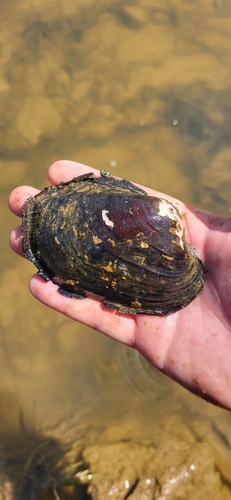
The Bleufer is characterized by its large, heavy, and inflated shell, which typically reaches lengths of 10 to 18 centimeters. Its outer surface is dark green, dark brown, or almost black, often showing faint green rays in younger specimens. The shell's shape is rectangular to oval, with a distinct posterior ridge. The most striking visual identifier is found on the inside of the shell: the nacre exhibits a gorgeous, highly iridescent deep purple, lavender, or pinkish hue, which contrasts sharply with its dark exterior.
Category
InvertebrateRarity
Common
Danger
1/5 · Very low
Snaps
Be the first to snap!
Because they filter water continuously, Bleufer mussels accumulate contaminants in their shells and tissues, making them valuable bioindicators for assessing river health.
The common name 'Bleufer' refers to the vivid, deep blue-purple color of the inner shell lining, which makes it easy to distinguish from other freshwater mussels.
Their larval young are completely dependent on the Freshwater Drum; if the drum population vanishes from a river system, the Bleufer cannot reproduce there.
Highly efficient suspension feeders capable of filtering several liters of water per hour, removing organic debris, algae, and bacteria to improve water quality.
Females host developing larval offspring inside specialized chambers of their gills before releasing them to parasitize host fish.
A strong, muscular, retractable foot that enables the mussel to burrow into substrates, anchor against strong river currents, and slowly migrate short distances.
The Bleufer feeds by filtering water through its incurrent siphon, straining out tiny organic particles, algae, and microorganisms.
Age differences: Larval glochidia absorb nutrients from host fish tissues, while juveniles and adults rely entirely on filter feeding.
Aplodinotus grunniens
The larvae of the Bleufer attach to the gills of this fish to metamorphose into juveniles.

Ondatra zibethicus
This mammal hunts for freshwater mussels along the riverbanks, leaving behind piles of cracked shells.

Procyon lotor
This opportunistic predator searches shallow waters for mussels, consuming them during low water periods.
No trait badges are assigned for this object yet.
No aliases listed yet.
Collections for this object will appear here as more themes are added.
Danger
1/5 · Very low
No special safety notes yet.
Compare body symmetry, shells, segments, legs, tentacles and how the animal moves. Invertebrates span many unrelated groups, so start with body structure. Invertebrate Identifier: upload a photo and compare the visible details.
8+ cm
0.1+ kg
10+ years
The Bleufer feeds by filtering water through its incurrent siphon, straining out tiny organic particles, algae, and microorganisms.
Typically found in medium to large rivers with moderate currents, semi-buried in substrates of mud, sand, or fine gravel.
Filtering
10000+
Zoom in to split clusters and explore where this object has been snapped.
Recent snaps will appear here as new observations are added.
Take the discovery with you
Snap it with Snappit to identify it, learn what makes it special, and add the discovery to your collection.