
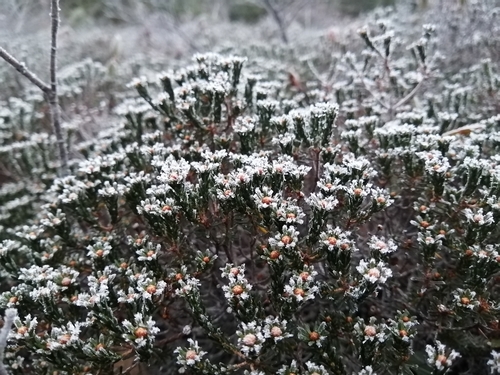


Broom Crowberry
corema conradii
The Broom Crowberry (Corema conradii) is a rare, dwarf, evergreen shrub that forms dense, cushion-like mats in some of the most nutrient-poor and harsh environments of eastern North America. Belonging to the heath family (Ericaceae), this resilient plant is specifically adapted to sandy pine barrens, coastal dunes, and rocky headlands. Because it grows in highly specialized, disturbance-prone ecosystems, it plays a vital ecological role in stabilizing shifting sands and providing microhabitats for ground-dwelling insects. What makes the Broom Crowberry truly remarkable is its evolutionary relationship with fire. While individual shrubs are highly flammable and easily destroyed by wildfires, their seeds are incredibly tough and remain dormant in the soil for decades. The intense heat of a forest fire triggers these seeds to germinate, allowing the species to quickly reclaim the post-burn landscape and prevent soil erosion.
Habitat: Found in open, sandy pine barrens, coastal sand dunes, and exposed rocky headlands with acidic, nutrient-deficient soils.
Broom Crowberry is a low-growing, highly branched shrub that reaches heights of 10 to 60 centimeters, often forming soft-looking, dome-shaped hummocks. Its tiny, needle-like leaves are bright to dark green, measuring only about 3 to 6 millimeters in length, and are arranged in alternating whorls that make the plant resemble a miniature conifer. In early spring, the plant displays its dioecious nature; male plants lack showy petals but produce spectacular, feathery clusters of deep purple-red filaments and anthers that release clouds of wind-borne pollen, while female plants produce inconspicuous, dry, greyish-brown berry-like drupes.
Category
PlantsRarity
Common
Danger
1/5 · Very low
Snaps
Be the first to snap!
In spring, the male plants erupt with clusters of deep purple-red stamens that lack petals, giving the sandy ground a delicate, hazy reddish-purple glow.
It is a dioecious species, meaning individual plants are strictly male or female, and only the females produce the dry berry-like fruits.
While adult plants are easily killed by fire, their seedbank requires fire to regenerate, making fire suppression one of the primary threats to their long-term survival.
Its seeds possess an extremely tough outer coat that requires the high temperatures of a wildfire to break dormancy and trigger germination.
The tiny, needle-like leaves have a thick waxy cuticle and rolled margins, minimizing water loss in arid, wind-swept sandy soils.
It is believed to release chemical compounds into the surrounding soil that inhibit the growth of competing vegetation, helping it maintain its open niche.
As an autotrophic plant, Broom Crowberry produces its own energy through photosynthesis, utilizing sunlight, water, carbon dioxide, and minimal soil minerals.

Pinus rigida
Co-dominates the acidic, nutrient-poor soils of the pine barrens, competing for sunlight and soil space.
Cladonia rangiferina
Competes for ground cover in open, sandy patches within coastal headlands and sand barrens.
No trait badges are assigned for this object yet.
No aliases listed yet.
Collections for this object will appear here as more themes are added.
Danger
1/5 · Very low
No special safety notes yet.
Compare how the fruit is clustered, the leaves and their arrangement, the stems and any thorns. Red, blue and black fruits grow on lots of unrelated plants, and the same color can show up on both edible and poisonous species. Berry Identifier: upload a photo and compare the visible details.
10-60 cm
15-40 years
As an autotrophic plant, Broom Crowberry produces its own energy through photosynthesis, utilizing sunlight, water, carbon dioxide, and minimal soil minerals.
Found in open, sandy pine barrens, coastal sand dunes, and exposed rocky headlands with acidic, nutrient-deficient soils.
Photosynthesis
Zoom in to split clusters and explore where this object has been snapped.
Recent snaps will appear here as new observations are added.
Take the discovery with you
Snap it with Snappit to identify it, learn what makes it special, and add the discovery to your collection.

















