





Buttercup-Leaf Suksdorfia
suksdorfia ranunculifolia
The Buttercup-Leaf Suksdorfia is a delightful little plant with bright green leaves that look like buttercup flowers! It adds a splash of color to its surroundings and is a favorite among butterflies.
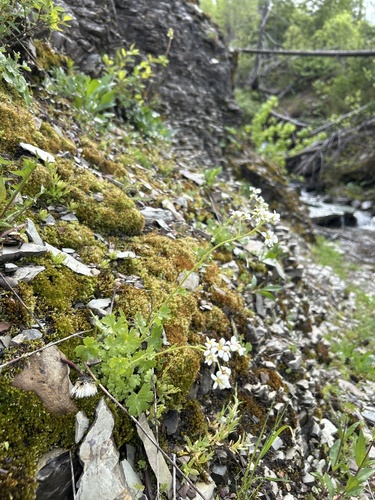
Habitat: It commonly grows in meadows, grasslands, and along forest edges.
The Buttercup-Leaf Suksdorfia is a small plant with deeply lobed, dark green leaves that cluster at its base, resembling those of a buttercup. Slender stems emerge, topped with delicate clusters of small, five-petaled white or pale purplish flowers, often found peeking from rocky crevices.
Category
PlantsRarity
Common
Danger
0/5 · No known danger
Snaps
1
It got its name from Wilhelm Suksdorf, a botanist who explored the Pacific Northwest!
Its tiny flowers are surprisingly hardy, often blooming high up on cold, rocky cliffs!
This plant is a master of disguise, its leaves look just like real buttercup leaves!
You can find this resilient little plant growing mostly in Washington and Oregon mountains!
Buttercup-Leaf Suksdorfia can grow roots into tiny rock crevices, helping it anchor firmly in challenging, exposed environments.
Buttercup-Leaf Suksdorfia has broad, basal leaves that help collect and funnel rainwater towards its roots, capturing precious moisture.
Buttercup-Leaf Suksdorfia has a low-growing form that protects its delicate flowers and leaves from strong winds and harsh weather.
Bombus occidentalis
Feeds on nectar and collects pollen from its flowers.
Andrena erythrogastra
Visits the small flowers for nectar and pollen.
Glomus mosseae
Exchanges nutrients and water with the plant's roots.
Colorful describes organisms or objects displaying a wide range of bright and distinct colors.
This trait characterizes organisms whose diet consists entirely or primarily of plant material.
Forest habitats are terrestrial environments dominated by dense tree cover, supporting a high diversity of plant and animal life.
Diurnal animals are primarily active during daylight hours, typically resting or sleeping at night.

Describes organisms that transfer pollen, enabling the fertilization and reproduction of plants.
Danger
0/5 · No known danger
No special safety notes yet.
The easiest way to identify Buttercup-Leaf Suksdorfia is to use the Snappit nature identifier app.
5-20 cm
5-10 cm
0.2-0.4 cm
Late spring to mid-summer
No
None
Perennial
Zoom in to split clusters and explore where this object has been snapped.
May 30, 2026
Great Northern Railway BuildingsPhoto attribution
(c) Taryn Brahmsteadt, some rights reserved (CC BY)
License: CC BY 4.0 ↗
Image may be shown cropped inside the card frame.
Take the discovery with you
Snap it with Snappit to identify it, learn what makes it special, and add the discovery to your collection.









.jpg&width=800)



_001.jpg&width=800)




