
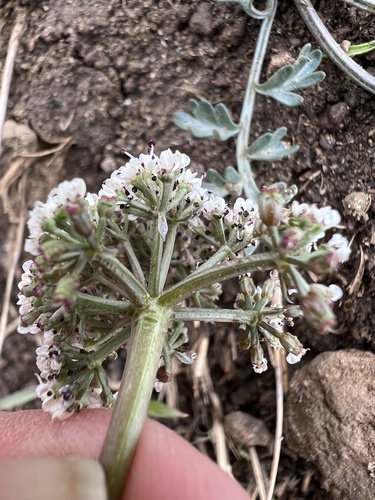


Canby'S Lomatium
lomatium canbyi
Canby's Lomatium (Lomatium canbyi) is a charming perennial herb native to the arid and semi-arid regions of western North America. A member of the carrot family (Apiaceae), this plant is a testament to resilience, often emerging and flowering in early spring when much of the landscape is still dormant. Its significance extends beyond its ecological role; the starchy, nutritious taproot has historically served as an important food source for indigenous peoples, earning it a place in traditional diets and cultures. Its ability to thrive in challenging environments makes it a unique and interesting species within its ecosystem.
Habitat: Canby's Lomatium is typically found in dry, open habitats such as sagebrush flats, grasslands, rocky slopes, and open ponderosa pine forests, often in sandy or gravelly soils.
This low-growing plant typically reaches heights of 10 to 30 centimeters. It features delicate, finely dissected leaves that are often basal, forming a feathery rosette close to the ground. The foliage is generally green, sometimes with a grayish tint. In spring, it produces small, vibrant yellow or yellowish-green flowers arranged in characteristic compound umbels, resembling miniature fireworks atop slender stalks. The overall appearance is quite distinctive, with its intricate leaf structure and bright floral clusters making it identifiable even among other Lomatium species.
Category
PlantsRarity
Common
Danger
1/5 · Very low
Snaps
Be the first to snap!
It belongs to the Apiaceae family, which also includes common vegetables like carrots, celery, and parsley, sharing a similar aromatic quality.
The feathery leaves and bright yellow flowers make it a striking sight against the often brown or gray backdrop of early spring landscapes.
The plant's common name 'biscuitroot' (often applied to various Lomatium species) comes from the flour-like consistency of its dried and powdered root.
The taproot of Canby's Lomatium was a significant traditional food source for various indigenous tribes, eaten raw, baked, or dried and stored for winter.
It possesses a deep, thickened taproot that allows it to access water reserves far below the surface, enabling survival in arid conditions where many other plants struggle.
This plant has adapted to complete much of its life cycle in early spring, capitalizing on available moisture and sunlight before the onset of summer drought and competition from taller vegetation.
Its starchy taproot is edible and highly nutritious, historically providing a vital food source for indigenous communities in the intermountain West during periods of scarcity.
Canby's Lomatium is a producer, generating its own food through photosynthesis using sunlight, carbon dioxide from the air, and water and minerals absorbed from the soil.
Andrena spp.
Pollinates flowers, aiding in reproduction.

Peromyscus maniculatus
Feeds on seeds, potentially dispersing them.

Thomomys talpoides
Consumes roots as a food source.

Various species
Forms symbiotic relationship to enhance nutrient uptake.
No trait badges are assigned for this object yet.
No aliases listed yet.
Collections for this object will appear here as more themes are added.
Danger
1/5 · Very low
No special safety notes yet.
Start with the whole plant, then compare leaf arrangement, leaf edges, stems and any flowers or fruit. Opposite leaves grow in pairs; alternate leaves come one at a time along the stem. These details tell you far more together than a single green leaf does. Plant Identifier: upload a photo and compare the visible details.
10-30 cm
0.005-0.05 kg
3-10 years
Canby's Lomatium is a producer, generating its own food through photosynthesis using sunlight, carbon dioxide from the air, and water and minerals absorbed from the soil.
Canby's Lomatium is typically found in dry, open habitats such as sagebrush flats, grasslands, rocky slopes, and open ponderosa pine forests, often in sandy or gravelly soils.
200-1000
Zoom in to split clusters and explore where this object has been snapped.
Recent snaps will appear here as new observations are added.
Take the discovery with you
Snap it with Snappit to identify it, learn what makes it special, and add the discovery to your collection.


















