

Caterpillar-Plant
scorpiurus muricatus
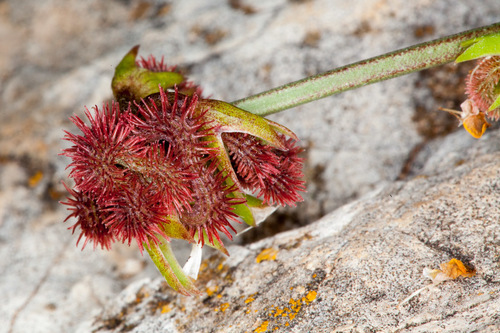
The Caterpillar-Plant (Scorpiurus muricatus) is a captivating, low-growing annual herb belonging to the legume family. Native to the sun-drenched fields and meadows of the Mediterranean region, this quirky plant earns its common name from its highly unusual seed pods. As the yellow, pea-like flowers fade, they give way to twisted, ribbed, and bristly pods that bear an uncanny resemblance to curled-up green or brown caterpillars. This remarkable mimicry makes it a popular ornamental curiosity in gardens around the world. Beyond its fascinating appearance, the Caterpillar-Plant plays a vital ecological role. Like many legumes, it forms a symbiotic relationship with soil bacteria to fix nitrogen, enriching the earth wherever it grows, and it is frequently utilized as a hardy forage crop for livestock.
Habitat: Found in dry, grassy meadows, disturbed soils, and open fields, particularly thriving in the warm, calcareous soils of the Mediterranean basin.
Scorpiurus muricatus is a sprawling herbaceous annual that typically reaches 10 to 60 centimeters in length. Unlike most legumes, it features simple, entire leaves that are somewhat spatulate or oval-shaped with distinct parallel veins. During the blooming season, it produces small, bright yellow, papilionaceous (pea-like) flowers held on slender stalks. The plant's most identifying characteristic is its distinct seed pods: tightly coiled, contorted legumes covered in soft bristles and longitudinal ribs, mimicking the segmented body of a resting caterpillar or a scorpion's tail. These pods transition from bright green to a woody brown as they mature.
Category
PlantsRarity
Common
Danger
1/5 · Very low
Snaps
Be the first to snap!
In the 16th century, European gardeners grew this plant specifically to use the bizarre seed pods as decorative oddities and in practical jokes.
Its scientific genus name, Scorpiurus, translates from Greek to 'scorpion's tail', referencing the tightly coiled, stinging look of the mature pods.
The seed pods look so much like real caterpillars that they are sometimes added to salads as a practical joke to surprise dinner guests!
Unlike most plants in the pea and bean family, which usually have compound leaves made of multiple leaflets, the Caterpillar-Plant has simple, undivided leaves.
Partners with Rhizobium bacteria in its root nodules to convert atmospheric nitrogen into a usable form, naturally fertilizing the soil.
Produces bizarre, coiled, bristle-covered seed pods that closely resemble caterpillars, which may deter certain herbivores or trick birds into aiding seed dispersal.
Exhibits resilient growth patterns that allow it to survive and successfully reproduce in the arid, sun-baked environments of the Mediterranean summer.
As a photosynthetic plant, it produces its own food using sunlight, water, and carbon dioxide, heavily supplemented by nitrogen fixed from the atmosphere.
Apis mellifera
Pollinates the yellow pea-like flowers while gathering nectar.
Rhizobium leguminosarum
Forms root nodules to fix atmospheric nitrogen for the plant.
Ovis aries
Grazes on the foliage, as the plant is a nutritious forage crop.
No trait badges are assigned for this object yet.
No aliases listed yet.
Collections for this object will appear here as more themes are added.
Danger
1/5 · Very low
No special safety notes yet.
Start with the whole plant, then compare leaf arrangement, leaf edges, stems and any flowers or fruit. Opposite leaves grow in pairs; alternate leaves come one at a time along the stem. These details tell you far more together than a single green leaf does. Plant Identifier: upload a photo and compare the visible details.
10-60 cm
1 years
As a photosynthetic plant, it produces its own food using sunlight, water, and carbon dioxide, heavily supplemented by nitrogen fixed from the atmosphere.
Found in dry, grassy meadows, disturbed soils, and open fields, particularly thriving in the warm, calcareous soils of the Mediterranean basin.
Photosynthesis
Zoom in to split clusters and explore where this object has been snapped.
Recent snaps will appear here as new observations are added.
Take the discovery with you
Snap it with Snappit to identify it, learn what makes it special, and add the discovery to your collection.