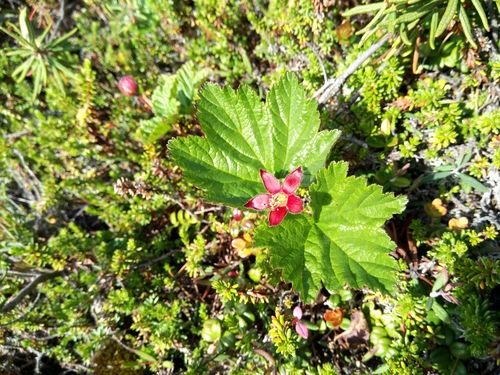


Cloudberry
rubus chamaemorus
The Cloudberry (Rubus chamaemorus) is a hardy, low-growing herbaceous plant prized for its highly valued, amber-colored edible fruits. Often referred to as 'arctic gold,' this boreal treasure thrives in the cold, acidic environments of northern peatlands, muskegs, and damp tundra. Unlike many other berries in the rose family, cloudberries grow individually on single, upright stems, making their harvest a patient, solitary endeavor. Deeply tied to northern cultures, particularly in Scandinavia and indigenous communities, cloudberries have a rich, complex flavor that is tart when fresh and creamy when ripe. They are highly sought after for culinary delicacies, preserves, and traditional medicines due to their exceptionally high vitamin C and antioxidant content.
Habitat: Found in acidic, nutrient-poor peat bogs, muskegs, and wet tundra across the boreal and arctic regions.
Cloudberries are low-growing plants, typically standing between 10 to 25 cm tall. Their leaves are distinctively hand-shaped, wrinkled, and kidney-shaped with five to seven lobes, turning a rich reddish-brown in the autumn. During late spring, they produce solitary white flowers with five petals. The berry itself undergoes a striking color transformation: beginning as a hard, greenish-red bud, it ripens into an enticing, translucent soft amber-orange berry that resembles a plump, delicate raspberry.
Category
PlantsRarity
Common
Danger
1/5 · Very low
Snaps
1
Cloudberries change color in reverse compared to most berries; they start red and hard, then become soft, translucent orange, and juicy as they ripen.
In Norway, cloudberries are so highly valued that there are laws regulating where and how much people can harvest from public lands.
The berries contain natural preservatives, specifically benzoic acid, which allows them to be stored in their own juice for long periods without spoiling.
The plant survives extreme arctic winters by dying back to its extensive underground rhizome system, which remains protected beneath the deep snowpack.
Cloudberries are dioecious, meaning individual plants are either exclusively male or female, which prevents self-pollination and promotes genetic diversity across colonies.
It utilizes symbiotic mycorrhizal fungi to absorb vital nutrients, such as nitrogen and phosphorus, from extremely acidic and nutrient-poor peat soils.
As a photosynthetic plant, the cloudberry produces its own energy using sunlight, carbon dioxide, and water while absorbing soil minerals.

Ursus arctos
Brown bears consume the berries in late summer to build fat reserves for hibernation.
Bombus polaris
Arctic bumblebees pollinate the flowers, which is critical since cloudberries are dioecious.
Lagopus lagopus
Willow ptarmigans feed on both the leaves and berries of cloudberries in tundra habitats.
No trait badges are assigned for this object yet.
No aliases listed yet.
Collections for this object will appear here as more themes are added.
Danger
1/5 · Very low
No special safety notes yet.
Compare how the fruit is clustered, the leaves and their arrangement, the stems and any thorns. Red, blue and black fruits grow on lots of unrelated plants, and the same color can show up on both edible and poisonous species. Berry Identifier: upload a photo and compare the visible details.
10+ cm
5+ years
As a photosynthetic plant, the cloudberry produces its own energy using sunlight, carbon dioxide, and water while absorbing soil minerals.
Found in acidic, nutrient-poor peat bogs, muskegs, and wet tundra across the boreal and arctic regions.
Zoom in to split clusters and explore where this object has been snapped.

Alaska, US
You might spot Canadian Bunchberry, Saskatoon, and Canadian Buffalo-Berry.
View guide →

Maine, US
You might spot Jack Pine, Lingonberry, and Sheep Laurel.
View guide →
Take the discovery with you
Snap it with Snappit to identify it, learn what makes it special, and add the discovery to your collection.