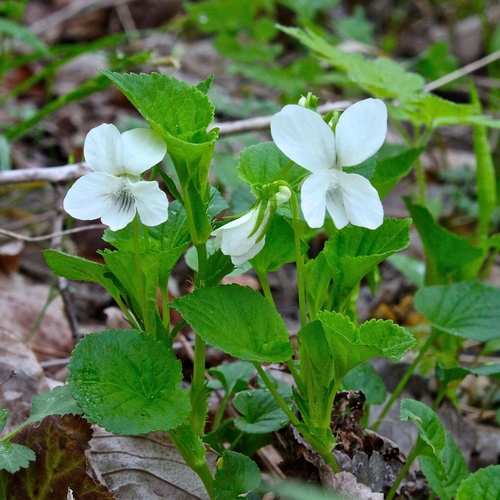


Cream Violet
viola striata
The Cream Violet is a charming perennial wildflower native to the moist forests and shaded valleys of eastern North America. Unlike many of its stemless relatives, this species produces leafy, branching stems that grow in attractive, low-lying mounds. It is highly appreciated by nature enthusiasts for its remarkably long blooming period, which begins in mid-spring and frequently extends well into the heat of summer. During this time, it offers a refreshing splash of light on the forest floor, serving as an important early-season resource for various native pollinators.
Habitat: Found in rich, moist deciduous woods, floodplains, stream banks, and shaded low meadows.
This wildflower features creamy white to pale ivory petals, with the blossoms measuring about 1.5 to 2.5 cm across. The lower petal is marked with delicate, dark purple-blue veins that act as nectar guides for insect visitors. Its bright green, heart-shaped leaves have finely serrated edges and alternate along sprawling, light-green stems that typically reach heights between 15 and 30 cm.
Category
PlantsRarity
Common
Danger
1/5 · Very low
Snaps
2
The dark purple stripes on the lower petals of the Cream Violet act like runway lights, guiding bees directly to the nectar source.
The species name 'striata' is Latin for 'striped' or 'grooved', referring directly to the purple lines on its white petals.
This plant produces two distinct types of flowers each year: showy, bee-pollinated ones in spring and hidden, self-pollinating ones in summer.
Produces inconspicuous, closed flowers near the ground in summer that self-pollinate without opening, guaranteeing seed production even if pollinators are scarce.
Equips its seeds with lipid-rich appendages called elaiosomes to entice woodland ants to carry the seeds to their nests, assisting in seed dispersal and protection.
Utilizes branching, upright stems unlike stemless violets, allowing it to lift its leaves and blossoms higher to better compete for filtered light in dense undergrowth.
As a photosynthetic plant, the Cream Violet manufactures its own energy using sunlight, water, carbon dioxide, and essential nutrients absorbed from rich, moist soils.
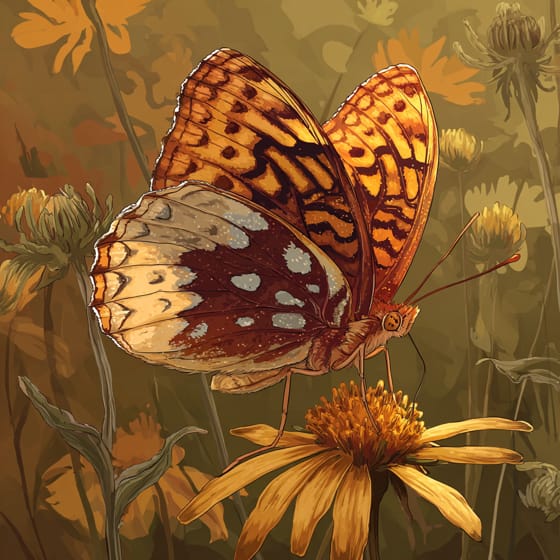
Speyeria cybele
The caterpillar larvae of this butterfly feed extensively on the foliage of the Cream Violet.
Andrena violae
This native bee specializes in visiting violet flowers, acting as a key pollinator in early spring.
Aphaenogaster rudis
This ant species collects the seeds of the Cream Violet, consuming the elaiosome and discarding the seed safely underground.
No trait badges are assigned for this object yet.
No aliases listed yet.
Collections for this object will appear here as more themes are added.
Danger
1/5 · Very low
No special safety notes yet.
The easiest way to identify Cream Violet is to use the Snappit nature identifier app.
15-30 cm
3-10 years
As a photosynthetic plant, the Cream Violet manufactures its own energy using sunlight, water, carbon dioxide, and essential nutrients absorbed from rich, moist soils.
Found in rich, moist deciduous woods, floodplains, stream banks, and shaded low meadows.
Zoom in to split clusters and explore where this object has been snapped.
Take the discovery with you
Snap it with Snappit to identify it, learn what makes it special, and add the discovery to your collection.












.jpg&width=800)



_001.jpg&width=800)




