





daisy fleabane
Erigeron strigosus
Daisy fleabane is a cheerful little flower that blooms in many colors, mostly white and purple. It grows in fields and gardens, bringing joy to everyone who sees it!
Habitat: Fields and gardens
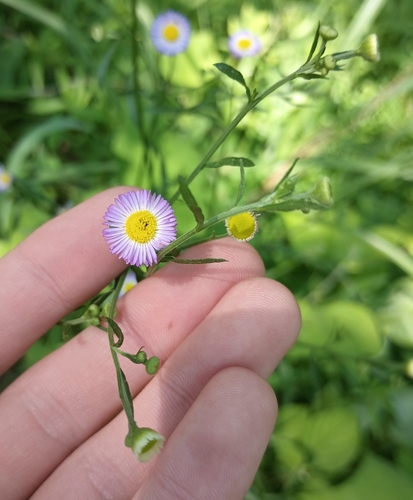
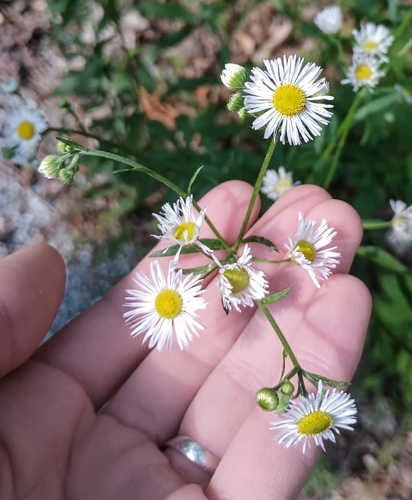
The daisy fleabane has numerous small, daisy-like flowers with many slender white to pale lavender ray petals radiating from a bright yellow central disk. Its fuzzy stems and lance-shaped leaves are common features.
Category
PlantsRarity
Common
Danger
1/5 · Very low
Snaps
5
Even tiny bees and flies find its nectar a delicious treat!
Its scientific name 'Erigeron' means 'early old man' because some species get fuzzy quickly!
The name 'fleabane' comes from an old belief it could banish pests!
This plant is a master at growing almost anywhere, even cracks in pavement!
Daisy fleabane can produce thousands of tiny seeds that easily float on the wind, helping it quickly colonize new sunny spots.
Daisy fleabane has strong roots and an adaptable nature, helping it thrive even in disturbed soils where other plants struggle.
Daisy fleabane has bright, open flowers that act like a landing strip, helping it attract many busy bees and butterflies.
Apis mellifera
collects nectar and pollen

Bombus impatiens
feeds on nectar and pollen
Vanessa cardui
sips sweet nectar
Lygus lineolaris
feeds on plant sap
Flowering plants are any plants that produce flowers as part of their reproductive cycle.
Spring blooming plants produce their flowers during the spring season, often signifying the end of winter and the start of new growth.
Summer blooming plants produce their flowers during the summer season, often providing vibrant color when many other plants have finished.
Fragrant flowers emit a pleasant aroma, often to attract pollinators or for defense.

Grassland habitats are terrestrial biomes dominated by grasses and herbaceous plants, supporting a variety of grazing animals.

Describes plants that are particularly attractive and beneficial to a wide range of pollinating organisms.

This habitat trait indicates species that can coexist with humans in urban and suburban environments, utilizing man-made structures and green spaces.
No aliases listed yet.
Danger
1/5 · Very low
Always look but don't pick flowers unless you have permission!
The easiest way to identify daisy fleabane is to use the Snappit nature identifier app.
30-90 cm
15-30 cm
1-2.5 cm
Late Spring to Fall
Yes
None
Biennial
Zoom in to split clusters and explore where this object has been snapped.
May 17, 2026
Caldwell Street Historic DistrictPhoto attribution
(c) Raven Dandridge, some rights reserved (CC BY)
License: CC BY 4.0 ↗
Image may be shown cropped inside the card frame.
May 17, 2026
Caldwell Street Historic DistrictPhoto attribution
(c) Raven Dandridge, some rights reserved (CC BY)
License: CC BY 4.0 ↗
Image may be shown cropped inside the card frame.

Georgia, US
You might spot Eastern Gray Squirrel, Domestic Cat, and American Robin.
View guide →

Ohio, US
You might spot Spotted Lanternfly, Virginia Springbeauty, and Blue Phlox.
View guide →

Pennsylvania, US
You might spot Meadow-Rues, Cinnamon Fern, and Pink Lady's Slipper.
View guide →

South Carolina, US
You might spot Butterfly Pea, Red-Tailed Hawk, and Northern Cardinal.
View guide →

Florida, US
You might spot Great Blue Skimmer, Blue Dasher, and Queen.
View guide →

Virginia, US
You might spot Echinacea, Southern Wild Raisin, and American Sweetgum.
View guide →
Take the discovery with you
Snap it with Snappit to identify it, learn what makes it special, and add the discovery to your collection.








.jpg&width=800)


_001.jpg&width=800)




