

Delta Unguiculatum
delta unguiculatum
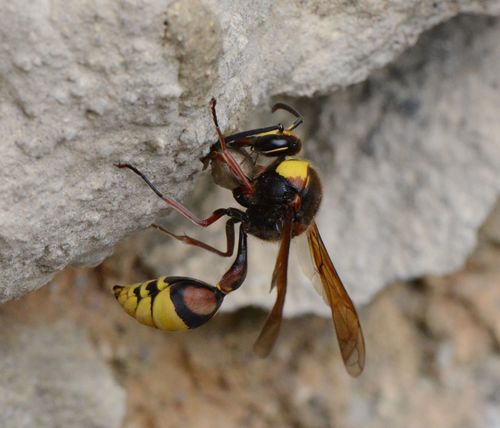
Delta unguiculatum, commonly known as the large potter wasp, is a striking and solitary insect renowned for its incredible architectural prowess. Unlike social wasps, individual females do not live in colonies; instead, they operate alone, constructing exquisite pot-like nests from mud and saliva attached to walls, rocks, or tree trunks. These masterfully crafted structures serve as secure nurseries for their offspring, showcasing a fascinating aspect of maternal care. Adult wasps are valuable pollinators, spending their days foraging on nectar-rich flowers. Despite their imposing size and formidable appearance, they are gentle giants of the wasp world, showing no aggression toward humans unless directly handled. Watching a female potter wasp meticulously gather mud and sculpt her nest is a truly mesmerizing experience for any nature observer.
Habitat: Found in warm, open environments including scrublands, forest edges, meadows, and suburban gardens, especially near clay-rich soils.
The Delta unguiculatum is a large, robust wasp, measuring between 2 to 3 centimeters in length. It features a distinctive coloration of black and reddish-orange or yellow bands across its abdomen and thorax. A key identifier is its exceptionally thin, elongated petiole (waist) connecting the thorax to the abdomen, which is characteristic of the potter wasp subfamily. Its wings are translucent with a dark brownish-amber tint, often held folded longitudinally when at rest. Its legs are mostly reddish-yellow, and the face has prominent yellow markings between its large compound eyes.
Category
InsectsRarity
Common
Danger
1/5 · Very low
Snaps
Be the first to snap!
Despite their large stinger used to paralyze prey, these solitary wasps are incredibly docile and will ignore humans unless actively squeezed or threatened.
Each mud pot created by the female wasp is crafted with a funnel-like rim that she carefully breaks off and seals after depositing her egg and prey.
The mother wasp suspends her single egg from the ceiling of the mud cell using a tiny silk thread, keeping it safe from the heavy, paralyzed caterpillars below.
Their mud nests are incredibly durable and can survive harsh winter weather, sometimes being reused by other solitary bee species the following spring.
The female wasp collects mud and mixes it with saliva to construct perfectly spherical, narrow-necked clay pots that dry into rock-hard nursery chambers.
Using highly targeted venom, the wasp paralyzes caterpillars without killing them, ensuring a fresh, living food supply for her hatching larvae.
Possesses excellent spatial memory, allowing the solitary wasp to navigate back to her precise nest location after foraging over long distances.
Adults feed exclusively on nectar for energy, while the carnivorous larvae feed on live, paralyzed caterpillars provided by the mother wasp.
Age differences: Larvae are strictly insectivorous, consuming paralyzed caterpillars inside the mud nest, whereas adults feed solely on sugary plant fluids like nectar.
Foeniculum vulgare
Adult wasps forage on the nectar of this plant, assisting in pollination.

Noctua pronuba
The female wasp hunts and paralyzes these caterpillars to stock her mud nests.
Stilbum cyanurum
This parasitic wasp lays its eggs inside the potter wasp's nest, and its larvae consume the host's egg or food.
No trait badges are assigned for this object yet.
No aliases listed yet.
Collections for this object will appear here as more themes are added.
Danger
1/5 · Very low
No special safety notes yet.
Look for six legs, antennae, three body sections and the shape of the wings. Beetles have hardened front wings; flies have just one working pair. Tiny insects may need a close view before their group is clear. Insect Identifier: upload a photo and compare the visible details.
2-3 cm
3-4 cm
0.0002-0.0005 kg
1 years
20 km/h
Adults feed exclusively on nectar for energy, while the carnivorous larvae feed on live, paralyzed caterpillars provided by the mother wasp.
Found in warm, open environments including scrublands, forest edges, meadows, and suburban gardens, especially near clay-rich soils.
Zoom in to split clusters and explore where this object has been snapped.
Recent snaps will appear here as new observations are added.
Take the discovery with you
Snap it with Snappit to identify it, learn what makes it special, and add the discovery to your collection.