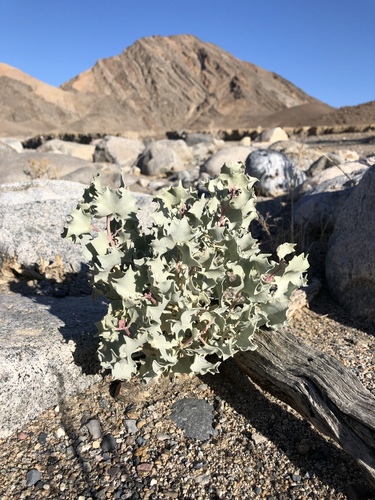


Desert Holly
atriplex hymenelytra
The Desert Holly (Atriplex hymenelytra) is an exceptionally hardy, evergreen shrub native to the extremely arid desert regions of the southwestern United States and northern Mexico. Easily recognized by its striking, silvery-white, holly-like foliage, this plant thrives in barren environments where few other species can survive, such as the alkaline flats of Death Valley. As a member of the saltbush family, it has evolved sophisticated physiological mechanisms to tolerate high salt concentrations and extreme heat. Beyond its ecological resilience, the Desert Holly plays a vital role in desert ecosystems by providing crucial forage and shelter for local wildlife during the harshest times of the year. Its unique, glowing appearance against dark desert soils makes it a favorite sight for hikers and nature enthusiasts exploring the arid American West.
Habitat: Found in extremely arid desert washes, gravelly alluvial fans, and alkaline flats below 1,000 meters elevation.
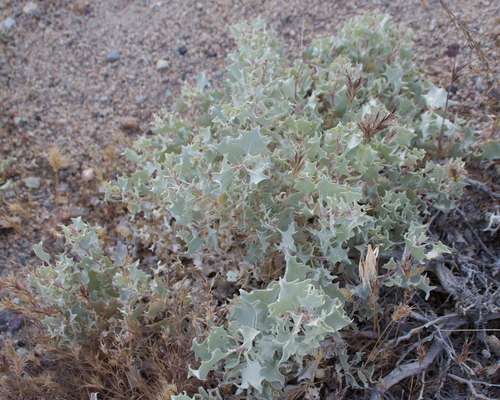
This compact, rounded shrub typically grows to a height of 30 to 100 centimeters. Its most identifying feature is its thick, crinkled, wedge-shaped leaves with deeply toothed margins that resemble traditional holly. The leaves are covered in a dense, scurfy layer of scale-like hairs and salt crystals, giving them a brilliant, reflective silvery-gray or white coloration. In late winter and early spring, the plant produces small, inconspicuous clusters of reddish-yellow flowers at the leaf bases.
Category
PlantsRarity
Common
Danger
1/5 · Very low
Snaps
8
Desert Holly can survive in some of the hottest and driest environments in North America, including Death Valley, where summer temperatures regularly exceed 120 degrees Fahrenheit.
Despite its name and holly-like leaves, Desert Holly is actually a member of the amaranth family and is closely related to spinach and beets.
The plant's silvery leaves are so reflective that early desert pioneers and miners reportedly used them as festive Christmas decorations.
Sheds excess salt through specialized glandular trichomes on its leaves, which burst to form a protective, reflective salt crust.
The silvery-white crust of salt and tiny hairs reflects intense desert sunlight, reducing leaf temperature and water loss.
Employs a highly efficient C4 metabolic pathway to synthesize sugars, allowing it to photosynthesize at extremely high temperatures and low moisture levels.
As a photosynthetic plant, Desert Holly produces its own food using sunlight, water, and carbon dioxide from the air.
Ovis canadensis nelsoni
Serves as a vital browse plant during dry seasons.
Hesperopsis alpheus
Serves as a larval host plant for the caterpillars.
No trait badges are assigned for this object yet.
No aliases listed yet.
Collections for this object will appear here as more themes are added.
Danger
1/5 · Very low
No special safety notes yet.
The easiest way to identify Desert Holly is to use the Snappit nature identifier app.
30-100 cm
10-30 years
As a photosynthetic plant, Desert Holly produces its own food using sunlight, water, and carbon dioxide from the air.
Found in extremely arid desert washes, gravelly alluvial fans, and alkaline flats below 1,000 meters elevation.
Zoom in to split clusters and explore where this object has been snapped.
Apr 9, 2026
Rainbow BasinPhoto attribution
(c) Donald Hampton, some rights reserved (CC BY-SA)
License: CC BY-SA 4.0 ↗
Image may be shown cropped inside the card frame.

California, US
You might spot Desert Holly, Western Joshua Tree, and Creosote Bush.
View guide →

California, US
You might spot Creosote Bush, Desert Holly, and Cottontop Cactus.
View guide →

California, US
You might spot Desert Holly, Desert Sunflower, and Desert Fivespot.
View guide →
Take the discovery with you
Snap it with Snappit to identify it, learn what makes it special, and add the discovery to your collection.











.jpg&width=800)



_001.jpg&width=800)




