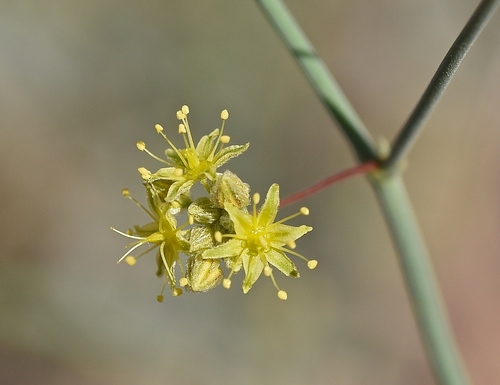


Desert Trumpet
eriogonum inflatum
The Desert Trumpet (Eriogonum inflatum) is one of the most curious and distinctive botanical residents of the North American deserts. Characterized by its strikingly inflated, hollow stems, this resilient plant stands out against the harsh, arid landscapes of the Mojave, Sonoran, and Great Basin deserts. Its unique swelling resembles small pipes or trumpets, giving rise to its evocative common name. The plant produces delicate clusters of tiny, bright yellow flowers at the tips of its branches, offering a stark and beautiful contrast to its structural, sculptural frame. Beyond its fascinating appearance, the Desert Trumpet is a marvel of desert adaptation, storing carbon dioxide inside its swollen stems to aid in photosynthesis.
Habitat: Found in dry, sandy, or gravelly washes, desert flats, and rocky slopes of the Southwestern United States and northwestern Mexico.
The Desert Trumpet is easily identified by its smooth, hairless, bluish-green stems that swell dramatically just below the branching joints, creating hollow, bottle-like structures up to several centimeters wide. The plant grows from a flat basal rosette of crinkly, spade-shaped leaves that often wither as the dry season progresses. At the tips of its skeletal, multi-branched stems, it bears loose clusters of tiny, bell-shaped yellow or greenish-yellow flowers, which eventually turn reddish-brown as they dry out. The entire plant typically reaches heights of 30 to 100 cm.
Category
PlantsRarity
Common
Danger
1/5 · Very low
Snaps
4
Historically, Indigenous peoples, such as the Paiute, dried the swollen stems and used them as natural smoking pipes.
Small desert wasps sometimes chew holes into the inflated chambers of the stems to use them as safe, sheltered nesting sites.
The stems are frequently inflated because they trap carbon dioxide gas, which can be up to 100 times more concentrated inside the stem than in the surrounding atmosphere.
The hollow, swollen stems store carbon dioxide, allowing the plant to continue photosynthesis even when its stomata are closed during hot, dry days to prevent water loss.
It grows a flat rosette of leaves during the winter rains to maximize moisture absorption, which then safely dies back during dry summers while the green stems continue photosynthesizing.
This species is known to tolerate soils high in heavy metals, particularly gypsum and clay, allowing it to colonize harsh areas where other plants cannot survive.
As a photosynthetic plant, the Desert Trumpet generates its own energy from sunlight, water, and carbon dioxide, drawing essential minerals from dry desert soils.
Apodemia mormo
The caterpillar of this butterfly feeds on the leaves and stems of the Desert Trumpet, while adults drink its nectar.
Pogonomyrmex rugosus
Ants collect and consume the seeds dropped by the Desert Trumpet, occasionally helping with seed dispersal.
Ovis canadensis nelsoni
Bighorn sheep occasionally browse on the succulent, moisture-rich inflated stems during dry periods.
No trait badges are assigned for this object yet.
No aliases listed yet.
Collections for this object will appear here as more themes are added.
Danger
1/5 · Very low
No special safety notes yet.
The easiest way to identify Desert Trumpet is to use the Snappit nature identifier app.
30-100 cm
0.05-0.5 kg
1-3 years
As a photosynthetic plant, the Desert Trumpet generates its own energy from sunlight, water, and carbon dioxide, drawing essential minerals from dry desert soils.
Found in dry, sandy, or gravelly washes, desert flats, and rocky slopes of the Southwestern United States and northwestern Mexico.
Zoom in to split clusters and explore where this object has been snapped.

California, US
You might spot Desert Holly, Western Joshua Tree, and Creosote Bush.
View guide →

Nevada, US
You might spot Engelmann's Hedgehog Cactus.
View guide →

California, US
You might spot Red Rock Tarplant and Red Rock Canyon Monkeyflower.
View guide →
Take the discovery with you
Snap it with Snappit to identify it, learn what makes it special, and add the discovery to your collection.











.jpg&width=800)



_001.jpg&width=800)




